




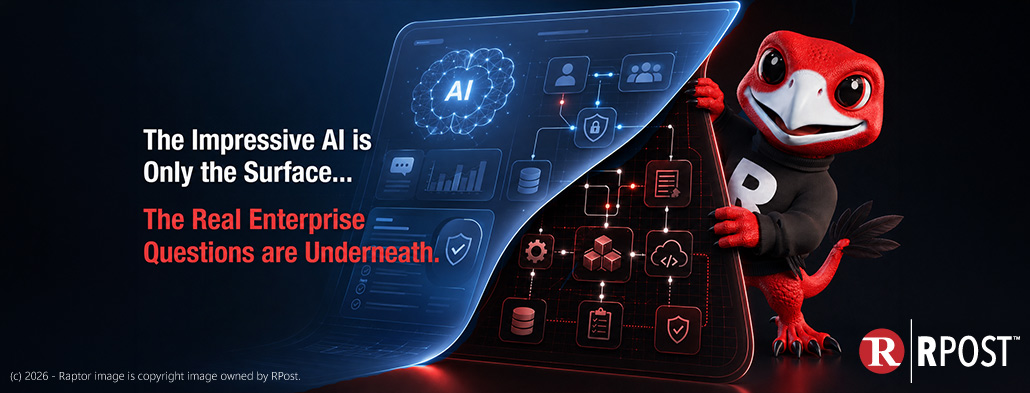
Rocky the Raptor here, RPost's cybersecurity product evangelist. I've noticed something interesting in conversations our teams are having with CIOs, CISOs, and technology managers lately: the AI demo is more nuanced.
A year or two ago, showing an executive an AI that could analyze a document, summarize a matter, detect a threat, or automate a workflow could carry a meeting. The technology itself was novel. Today, sophisticated buyers increasingly arrive having done their homework. They want the problem defined, the stakeholders identified, and the information architecture understood before they spend much time looking at another clever AI tool.
This isn't AI fatigue; this is AI buyer sophistication!
Consider what happens when an organization evaluates an AI system that can read documents and communications. The demonstration may be impressive, but the CIO's problem begins after the demo - where are those documents? Who has access to them? What permissions already exist? Does connecting the AI to SharePoint, a DMS, a practice-management platform, CRM, or Microsoft 365 preserve those controls, or does it quietly create a new information bridge around them?
A law firm makes the issue especially clear. Two lawyers may work for the same firm and use the same document management system but intentionally be prevented from seeing each other's matters. Connect an AI agent across that repository and suddenly the interesting question isn't whether it can produce a brilliant summary; it’s whether the AI understands the information barrier and whether the internal AI learning may give a lawyer working on a competing matter unfair insight.
The same issue exists everywhere. Financial institutions separate customer, research & transaction information; manufacturers restrict engineering designs and supplier data; corporations tightly control M&A, board, and litigation materials. The fact that AI can read something doesn't mean it should.
This is why governance is rapidly becoming the harder AI conversation.
Buyers now want to understand identity, inherited permissions, data residency, retention, model training, logging, and auditability. They want to know what happens when an employee's permission changes in the source repository. Increasingly, they also need to understand what an AI agent is authorized to do after it reads something.
That last distinction matters. Giving a software permission to read a document is one thing. Giving an autonomous agent permission to read, reason, communicate, and act is quite another. Prompt injection is something many casual users don’t even understand. Rogue agents using DarkAI are in operation and many end users of email may not understand the sophistication of AI era threats. Excessive AI privileges turn ordinary business content into potential instructions. AI therefore expands not only the productivity surface but also the attack surface.
This changing buyer mentality is particularly interesting for us at RPost.
We have spent years connecting into the places where important business information already moves - emails, documents, signatures, transactions, and workflows - rather than asking customers to move everything into another information silo. Our products - RMail®, RDocs®, RSign®, and RPostONE™ integrate into existing business environments, while RAPTOR™ AI adds intelligence across those communications and content surfaces.
That architecture becomes more relevant in the AI era.
RAPTOR AI Observability, for example, is designed to help identify where AI is appearing in communications and where sensitive information may be entering AI-assisted workflows. RDocs adds controls over what happens to sensitive content after it is shared, including protection against unintended AI ingestion. PRE-Crime™ cyber counterintelligence looks beyond traditional endpoints for suspicious interaction and reconnaissance and can now detect deepfake impersonators joining, for example, an HR web meeting interview. RMail adds security, data protection, and compliance around the communications channel where much of this information actually travels. RPost's own recent AI Observability work specifically focuses on email as an important visibility gap left by browser-, API-, and application-centric governance tools.
And increasingly, the integration conversation isn't simply API versus no API. APIs remain essential, while MCP creates a potentially elegant way for AI agents to orchestrate authorized actions across systems. But MCP doesn't eliminate governance. In some ways it makes governance more important because it makes connecting AI to business systems much easier.
Easy connectivity without information governance is simply a faster way to connect things that perhaps should never have been connected.
That may explain why RPost teams are spending so much time in the field talking directly with CIOs, CISOs, and technology managers. The useful conversations today aren't primarily about who has the flashiest AI. They're about architecture diagrams, information flows, permissions, threat surfaces, deployment, and measurable business outcomes.
The AI spectacle got everyone's attention. Now comes the more consequential phase: figuring out what actually works inside a real enterprise.
For technology buyers, and fortunately for those of us like me, Rocky the Raptor, who like getting into the technical weeds, that is where things are finally getting interesting!

October 09, 2026
October 01, 2026
September 25, 2026
September 18, 2026
September 16, 2026





 Blog
Blog