




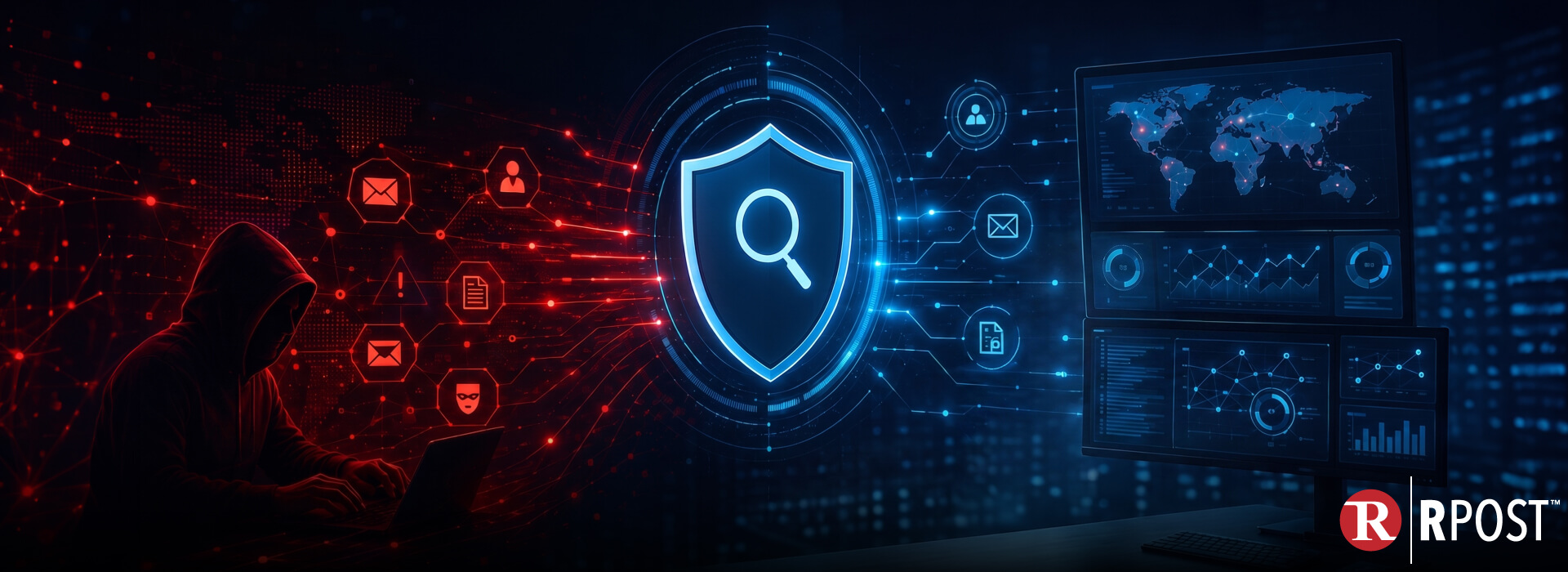
Real-time threat detection used to be treated as an advanced security capability. Today, it is becoming a basic requirement for enterprises that cannot afford delayed visibility.
Cybercriminals are no longer waiting for obvious attack paths. They use AI-written phishing emails, compromised accounts, lookalike domains, reply-chain hijacking, MFA bypass tactics, and business email compromise schemes that look like normal business activity. Many attacks now move through trusted channels: email threads, shared documents, vendor workflows, payment requests, and external communications.
The risk is not only that attacks are faster. The risk is that they look normal for longer.
A phishing email may not contain poor grammar. A malicious link may be clean when first scanned. A vendor message may come from a real account. A sensitive document may be safe when sent, then exposed later through forwarding or unusual access. A cybercriminal may use leaked data and dark AI tools to build a message that sounds like it belongs in the conversation.
This is why real-time threat detection is no longer optional for cybersecurity.
Enterprises need live threat signals, active threat monitoring, and early warning indicators that show when risk is forming. For CISOs, CIOs, SOC teams, Microsoft 365 and Google Workspace administrators, and risk leaders, the question is no longer only “Can we block known threats?” It is “Can we see the attack before it becomes a business event?”
Real-time threat detection is the ability to identify suspicious activity as it happens, or as risk signals begin to form.
It is not limited to one control or one system. It can include email activity, file access, account behavior, user actions, endpoint signals, cloud activity, external reconnaissance, recipient behavior, and threat intelligence.
In practical terms, real-time threat detection helps security teams answer questions such as:
The best real-time cyber threat detection does more than raise alerts. It gives threat context. It helps teams understand what is at risk, who is involved, whether the activity is normal, and what action may be needed.
Speed matters. Context matters more.
Delayed detection gives attackers time.
A phishing email can reach users before security teams see the pattern. A compromised account can stay active long enough to monitor conversations. A sensitive document can be forwarded outside the organization. A vendor fraud attempt can move from email to payment approval. A leaked file can be used to build an AI-assisted lure for the next attack.
In many business email compromise cases, the attacker does not need to deploy malware. The attacker needs to influence a human decision.
That decision may be to change a payment account, open a document, share credentials, approve an invoice, sign a contract, or respond to a trusted sender. By the time the threat becomes obvious, the business process may already be moving.
Delayed detection also creates investigation problems. Teams may be forced to reconstruct what happened after the fact. Who received the message? Who opened the file? Was the content forwarded? Was the recipient account compromised? Was the request part of a larger attack path?
The longer the delay, the harder it is to reduce impact.
Real-time monitoring helps close this gap. It gives security teams earlier signals and lets them act while the risk is still in motion.
Traditional security monitoring still has value. Periodic scans, static rules, known-bad indicators, endpoint alerts, inbox scanning, and manual log review all support enterprise security.
The issue is that modern attacks are built to avoid obvious signals.
A cybercriminal may use a new domain that is not yet on a blocklist. They may send a low-volume message to one finance user. They may use a legitimate service to host a link. They may compromise a third-party account that already has a relationship with the organization. They may use AI-generated language that matches the tone of a real business exchange.
Traditional monitoring often looks for clear evidence. Modern attacks may only show weak signals at first.
For example, a clean email from a known vendor may pass inbound scanning. A link may be safe during inspection, then redirect later. A shared document may not contain malware, but may still expose sensitive information. A user may open a file from an unusual location that suggests account compromise or external surveillance.
Endpoint-only detection also has limits. Many attacks form outside the endpoint. They start in email threads, vendor accounts, customer mailboxes, document access paths, or third-party workflows. If the security stack only watches internal systems, it may miss the early external signals.
Real-time threat detection must include the communication and content paths where business risk actually moves.
AI has changed the economics of cybercrime.
A threat actor can use AI to write more believable phishing messages, personalize lures faster, study business relationships, summarize leaked documents, create fake identities, and test different versions of an attack. They can automate reconnaissance across public websites, social profiles, breach data, job listings, filings, and vendor references.
This makes attacks more contextual.
A finance team may receive a payment message that refers to the right supplier and timing. A legal team may receive a document request that matches an active matter. A procurement user may see a message that looks like a routine vendor update. A senior executive may receive a note that mimics the tone of a trusted advisor.
AI also helps attackers move from broad phishing to focused manipulation. The final message may look harmless because the real payload is the instruction, not the file or link.
Automation makes the timeline shorter. Attackers can gather context faster, create lures faster, and change infrastructure faster. Security teams cannot rely on delayed reports and after-the-fact review when the attack path is moving in real time.
This is why AI threat detection and continuous threat detection are becoming more important. Enterprises need to detect suspicious activity while it is forming, not after the attacker has already shaped the workflow.
Real-time alerts without context can create noise.
SOC teams already face too many signals. Another dashboard does not help if every event looks urgent and nothing is explained. Real-time threat detection only works when it helps teams understand risk in plain terms.
Good threat context answers:
This is especially important for email threat detection and document security. A message may look normal on its own. A document open may look harmless on its own. A vendor interaction may look routine on its own.
The risk becomes clearer when these signals are connected.
For example, a sensitive document is sent to a vendor. Soon after, it is accessed from an unexpected geography. A related email thread shows unusual behavior. A new request appears asking for a payment or document update. Each event may be weak alone. Together, they may show a forming business email compromise attempt.
Real-time threat detection must connect live threat signals with business context.
Many enterprises have strong visibility into endpoints, networks, identity systems, and cloud applications. They also have inbound email security tools that scan messages before they reach users.
The gap often appears after delivery.
What happens after a sensitive email is sent? Who opens the document? Is the recipient environment risky? Was the file forwarded? Can access be revoked? Can the sender prove what was delivered, when, and to whom? Can the organization stop access if suspicious activity appears later?
These questions matter because modern attacks often exploit trusted communications.
Email remains one of the most common paths for business fraud, impersonation, credential theft, and data leakage. Documents are also high-value assets. Contracts, invoices, customer records, financial files, HR documents, legal notices, and board materials can create risk long after they leave the sender’s environment.
Traditional inbox scanning may not answer what happens after send. Endpoint monitoring may not see what happens inside a third-party recipient environment. Basic file sharing may not give enough control once the document is outside the enterprise.
This is where real-time cyber threat detection needs to extend into outbound communication, shared content, and recipient-side behavior.
Threat intelligence and real-time threat detection are related, but they are not the same.
Threat intelligence helps teams understand known and emerging risks. It may include attacker tactics, threat actor behavior, indicators of compromise, domain intelligence, malware trends, industry targeting, and campaign patterns.
Real-time threat detection identifies risk signals as they appear. It looks at current activity and asks whether something suspicious is happening now.
Preemptive cybersecurity goes earlier in the attack timeline. It looks for signs that an attack is being prepared before it fully reaches the business process. This may include reconnaissance detection, suspicious external activity, risky recipient behavior, or unusual access around sensitive content.
All three layers matter.
Threat intelligence tells you what to understand. Real-time detection tells you what is happening. Preemptive cybersecurity helps you see what may be forming before the attacker reaches the point of impact.
For enterprises, the strongest approach combines these capabilities. Teams need intelligence, live detection, and early action.
Real-time detection is often associated with alerts during an attack. Preemptive cybersecurity moves the focus earlier.
Instead of waiting for the phishing email, compromised login, or fraudulent instruction, preemptive cybersecurity looks for external threat signals and early warning indicators. It asks whether threat actor behavior is already forming around the enterprise’s communication paths.
This is important because many attacks begin outside the enterprise perimeter.
A cybercriminal may monitor a vendor account, study message timing, observe document exchanges, or test access to sensitive content. They may not be attacking the enterprise system yet. They may be preparing the context needed to make the final attack convincing.
Preemptive cybersecurity helps security teams identify that preparation stage.
For example:
This is a more active model. The goal is to detect risk before business teams are manipulated, before files are misused, and before transactions are redirected.
RPost helps enterprises strengthen real-time threat detection around the communication and content workflows where modern cyber risk often forms.
RAPTOR AI supports PRE-Crime cybersecurity and threat intelligence. It helps identify cybercriminal reconnaissance, suspicious activity, external threat signals, and risk patterns that may appear before the attack fully lands.
RMail helps protect sensitive email through secure email, encryption, threat detection, privacy, compliance support, tracking, and outbound controls. This is useful for teams that handle regulated or high-value communications across finance, legal, HR, procurement, customer service, and executive workflows.
RDocs extends control after delivery. It helps track document activity, manage access, restrict use, revoke access, and kill access when risk appears. This matters because sensitive files often remain valuable after they leave the organization.
Registered Email provides legal proof of delivery, time, content, and privacy. This helps enterprises preserve evidence for critical communications, disputes, compliance reviews, and incident investigations.
RPostONE brings these capabilities into a broader secure communications and intelligent content control platform. It gives enterprises a practical layer for detecting, proving, protecting, and controlling risk across email, documents, and digital workflows.
The key point is that RPost does not need to replace an enterprise’s existing security stack. It can add a layer of visibility and control around outbound communication, shared content, third-party exposure, and pre-attack intelligence.
For CISOs and CIOs, this is the value: stronger security around the workflows where business decisions happen.
Real-time threat detection is no longer a “nice to have” capability. Modern attacks move too quickly, use too much context, and exploit too many trusted channels for delayed detection to be enough.
Cybersecurity monitoring must move beyond periodic scans and known-bad indicators. Enterprises need continuous threat detection, real-time monitoring, threat context, and automated response options that help teams act before damage spreads.
AI makes this more urgent. Dark AI and automation allow cybercriminals to create hypercontextual lures, monitor business relationships, study leaked data, and attack through channels that look normal to users.
The next step is earlier visibility.
Real-time threat detection should not only mean faster alerts. It should mean earlier insight into attack signals before sensitive communications, files, or transactions are exposed.
RPost helps enterprises move in that direction with RAPTOR AI, RMail, RDocs, Registered Email, and RPostONE.
See how RPost helps detect and control risk before, during, and after delivery.

October 07, 2026
September 30, 2026

September 25, 2026

September 18, 2026

August 20, 2026





 Cybersecurity Insights