

AI adoption inside the enterprise is moving faster than most security programs can comfortably govern.
An employee needs to summarize a long customer email thread, so they paste it into an AI assistant. A finance analyst uploads a spreadsheet to help identify unusual transactions. Someone in legal asks a generative AI tool to simplify a contract clause. HR uses an AI writing assistant to rewrite a performance review. A sales executive uploads a proposal to improve its wording before sending it to a prospect.
None of these actions necessarily looks malicious. In fact, each one may save time and improve productivity.
That is precisely what makes shadow AI risks difficult to manage.
The problem is not simply that employees are using artificial intelligence. The problem begins when sensitive business data moves into AI systems without the organization knowing what was shared, whether the tool was approved, what happens to the information afterward, or whether security teams have any meaningful way to respond.
For CISOs, this changes the question around enterprise AI security. Organizations cannot focus only on securing the AI applications they officially deploy. They also need to understand where sensitive information can travel, who can access it, what controls follow it, and how quickly the organization can respond when something goes somewhere it should not.
Shadow AI is the use of AI tools, applications, or services without formal approval, visibility, or governance from IT, security, compliance, or other responsible teams.
It is the AI-era version of shadow IT, but potentially with a much more direct connection to enterprise information.
Employees can access public generative AI tools from a browser, install AI extensions, connect AI meeting assistants, use document summarizers, create personal AI accounts, or experiment with specialized applications that promise to automate parts of their work.
The business motivation is understandable. Employees are trying to work faster.
The security problem is that an AI tool can become another destination for enterprise data.
A confidential document that once moved between an employee's inbox, an approved document system, and an authorized recipient may now be copied into a prompt, uploaded to an external AI service, summarized by a browser extension, or processed through a third-party AI assistant.
Security teams may never see that additional step.
That is where shadow AI risks become a data security problem rather than simply an application-management problem.
Enterprise adoption of AI is not following the traditional software procurement model.
Employees do not necessarily need IT to install a large application or provision new infrastructure. Many generative AI tools can be accessed through a browser within seconds. Some can be connected to existing business applications with similarly little friction.
At the same time, employees are under pressure to use AI because its productivity benefits can be significant. Marketing wants faster research. Sales wants better proposals. Legal wants faster document analysis. Finance wants help working through large datasets. Executives want meeting summaries. Developers want coding assistance.
The gap between those productivity demands and formal AI governance creates room for shadow AI.
Policies can also struggle to keep pace. A company may approve one enterprise AI assistant while employees continue experimenting with other tools. Security may block several known services while browser extensions or newly launched applications create alternative routes. An employee may understand that customer records should not be uploaded to an unapproved application but fail to recognize that pasting a portion of a customer email into a prompt creates essentially the same data exposure risk.
This makes employee AI use as much a content problem as an application problem.
Knowing which AI tools exist matters. Knowing what information employees are putting into them matters more.
When organizations think about AI data leakage, they may picture someone uploading an entire database to a public generative AI platform. Real-world exposure can be much less dramatic.
Consider a lawyer reviewing a commercial agreement. Rather than uploading the entire contract, the lawyer copies several complicated clauses into an AI assistant and asks for a summary. Those paragraphs may contain customer names, pricing, obligations, negotiation positions, or other confidential information.
A finance employee might upload a spreadsheet because they want help finding anomalies. The file could contain account information, invoices, payment instructions, forecasts, or customer data.
An HR manager could ask an AI writing tool to improve the language in an employee review without considering that the prompt now contains identifiable employee information.
An executive assistant might use an AI tool to summarize a long email conversation about a proposed acquisition.
Each action is ordinary work. Each can also move sensitive business data outside the organization's intended control boundary.
Common exposure paths include document uploads, prompt sharing, copied email content, browser-based AI extensions, AI meeting assistants, third-party AI tools, and personal AI accounts used for business purposes.
The important distinction for security leaders is that confidential data exposure does not require an employee to deliberately share a confidential file. A few copied paragraphs can carry enough business context to create risk.
Shadow AI risk cuts across departments because almost every function now works with information that could be useful to an AI assistant.
Legal teams handle contracts, privileged communications, settlement discussions, litigation material, acquisition documents, and other sensitive legal documents. Finance teams work with forecasts, banking information, invoices, payment instructions, financial records, and transaction data.
HR departments manage employee records, payroll information, performance reviews, compensation details, and other HR data. Sales teams hold customer lists, proposals, account strategies, pricing, and negotiation details.
Operations teams exchange vendor files, project documentation, supplier information, internal procedures, and technical information with third parties. Senior executives may handle board materials, strategy documents, acquisition discussions, product roadmaps, and other information whose value depends heavily on confidentiality.
The risk is therefore not confined to a particular file format or data classification.
It is about sensitive information security across the workflows where people communicate, collaborate, share files, and increasingly ask AI systems for assistance.
Traditional data loss prevention remains important, but shadow AI exposes several limitations in relying on perimeter controls alone.
Blocking known AI websites, for example, can reduce access to specific services but cannot address every new application, browser extension, personal account, or AI capability embedded in another platform.
DLP can detect many forms of restricted information, but content does not always leave in its original form. Employees can paste excerpts, rewrite text, summarize documents, or manually transfer information between systems.
Access permissions create another challenge. An employee may legitimately have access to a confidential contract because they need it for their job. That does not necessarily mean every AI application they use should inherit access to the information in that contract.
The same issue appears with external sharing.
A business can securely deliver a document to an authorized customer, supplier, law firm, consultant, or partner, but the sender's control may weaken significantly once an ordinary file is downloaded or forwarded. That third party may then use its own AI assistants or generative AI tools, outside the sender's security environment.
This is why enterprise AI security increasingly needs to consider what happens to content both before and after it leaves the organization's immediate systems.
Shadow AI does not create an entirely new category of sensitive data. It creates new ways for existing sensitive information to travel.
Imagine a customer complaint received by email. An employee copies the conversation into a public AI tool and asks it to draft a response. The employee sees a productivity shortcut; the security team sees customer data leaving an approved communication environment.
Or consider a vendor sending a confidential technical document to an employee. The employee wants a quick summary and uploads it to an AI assistant. The original sender may have no idea the information has now entered another system.
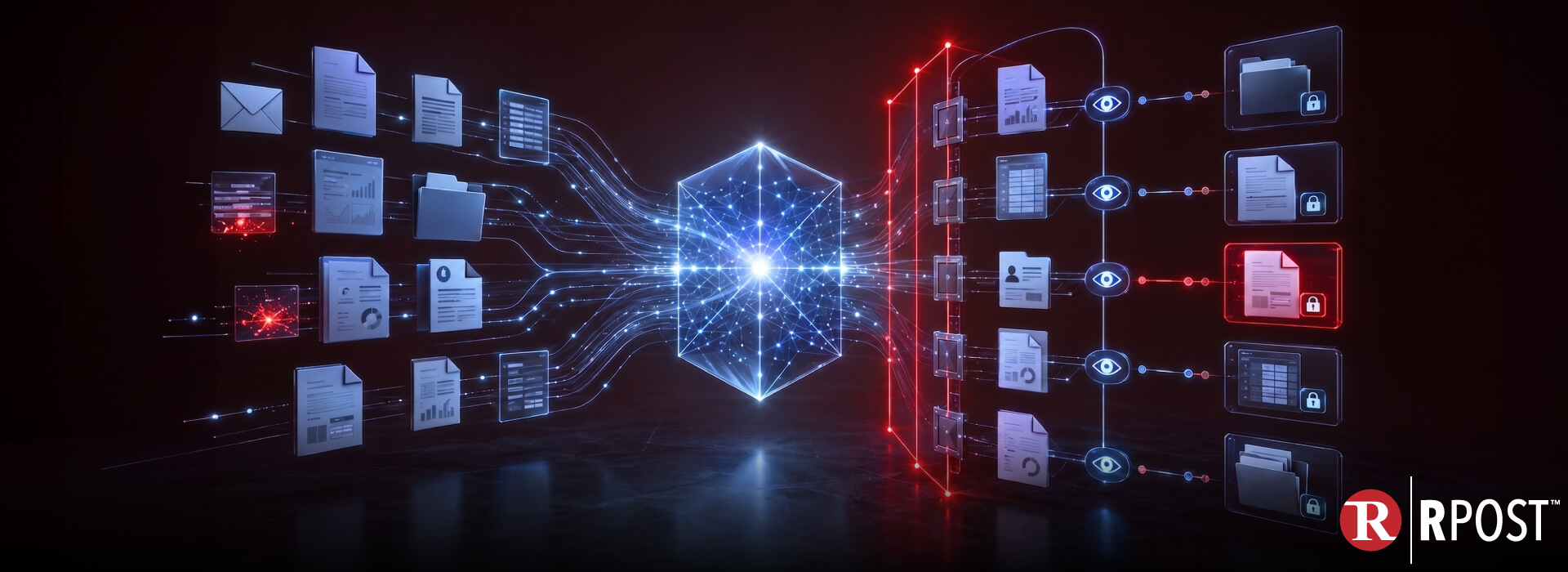
A confidential email thread can be copied into an AI chat. A financial spreadsheet can be uploaded for analysis. A contract can be sent to an AI document reviewer. A strategy presentation can be summarized through an unapproved application.
In each case, the risk begins with information that the employee was probably authorized to see.
That is what makes AI data security different from simply stopping unauthorized access.
Organizations also need to think about authorized people taking sensitive information into unauthorized workflows.
An effective AI governance program should answer more than one question.
Which AI tools are approved is important. But enterprises also need to define what information those tools can process, which employees can provide it, which business functions require stronger restrictions, and what happens when content moves outside an approved environment.
That requires security teams to think at the content level.
A useful governance framework should address which data classifications can be shared with AI services, how confidential documents are distributed, how access permissions are managed, what audit trail exists for sensitive communications, and whether access can be changed when risk conditions change.
The distinction becomes particularly important for legal, finance, HR, executive, and regulated workflows, where the document itself may continue moving after its initial delivery.
A broader business data protection strategy therefore combines application governance with access control, content control, secure file sharing, email encryption, document tracking, monitoring, and employee education.
The objective is not to prevent people from using AI.
It is to prevent productivity from silently becoming exposure.
One of the hardest moments in data security occurs after sensitive information leaves the sender's immediate environment.
Traditional security controls are often strongest before delivery. Organizations can classify information, inspect outgoing communications, encrypt email, apply DLP policies, and restrict access within managed repositories.
But a file sent to a customer, partner, supplier, consultant, or other third party may enter an environment the sender does not manage.
It may be downloaded. It may be forwarded. It may remain accessible long after its original purpose has passed. It may be stored in an unmanaged location or introduced into a new workflow, including an AI system.
That makes post-delivery control increasingly relevant to GenAI data security.
Organizations should consider whether highly sensitive documents need controls that remain associated with the content after distribution. Depending on the sensitivity and business process, that could include restricting who can view the information, setting expiration or viewing limits, tracking document activity, changing supported access permissions, or revoking future viewing when circumstances change.
Post-delivery controls cannot erase information someone has already legitimately captured or learned. They can, however, reduce the assumption that sending a sensitive document must mean permanently surrendering control over future access.
That distinction becomes more important when AI can make copying, summarizing, analyzing, and reusing information exceptionally easy.
There is no single product or policy that eliminates shadow AI. The stronger approach is layered: govern AI use while reducing unnecessary exposure of the information AI systems might consume.
Organizations can start with several practical measures:
Employee education is especially important. "Do not use unauthorized AI" is unlikely to be enough.
Employees need examples.
Do not paste a confidential customer email into an unapproved AI assistant. Do not upload an acquisition document to a personal AI account for summarization. Do not send employee records to a public AI service because it makes spreadsheet analysis easier.
Those examples turn abstract AI governance into decisions people can recognize during everyday work.
For CISOs, the longer-term objective should be AI observability combined with content control: understand where AI is being used while limiting how easily sensitive content can become uncontrolled input for those systems.
RPost approaches this problem from the information side of the equation.
RMail helps organizations secure sensitive email communications with capabilities including encryption and privacy controls, helping protect information while it is being communicated.
Registered Email™ adds verifiable records around important communications, providing evidence associated with what was sent, when it was sent, and delivery events. For organizations dealing with regulated or high-value communications, that evidence can strengthen accountability and auditability.
RDocs™ extends the security model beyond the initial send. Documents can be converted into RPD™ Rights Protected Documents that open through a browser while carrying selected access policies. Depending on the controls applied, organizations can restrict readers, set access or viewing limits, monitor permitted document activity, apply identity markings, and change supported access settings or revoke future viewing after distribution.
This is particularly relevant to shadow AI because the risk does not always stop at the employee. Sensitive documents routinely move to customers, suppliers, professional advisers, partners, and other external recipients whose AI environments the originating enterprise cannot govern.
RDocs gives organizations another layer of control over the document itself rather than assuming security ends once a file crosses the enterprise boundary.
RAPTOR™ AI adds RPost's PRE-Crime™ approach to identifying risk earlier, including threat intelligence and signals designed to identify suspicious activity before additional sensitive context is exposed. Across the broader RPostONE platform, these capabilities bring secure communications, content controls, resilience, and automation into a more connected approach.
Shadow AI is ultimately a warning about how quickly enterprise information can move beyond the systems designed to protect it.
Organizations absolutely need policies governing employee AI use. They need approved tools, AI security controls, training, monitoring, DLP, and clear accountability.
But CISOs should also ask a more fundamental question:
In an environment filled with AI assistants, copilots, document analyzers, browser extensions, third-party platforms, and increasingly autonomous AI agents, controlling every destination will become difficult.
Protecting the content itself therefore becomes an increasingly important part of the strategy.
The enterprises best prepared for the AI era will not be those that simply block the most AI tools. They will be those that know where their sensitive information is going, reduce unnecessary access, preserve evidence around important communications, and maintain meaningful control for as long as the information remains valuable.
Because with shadow AI, the critical security event may not be when an AI system generates an answer.
It may have happened moments earlier, when sensitive business data quietly left your control.
September 25, 2026

September 18, 2026

August 20, 2026

August 12, 2026
August 04, 2026





 Cybersecurity Insights