


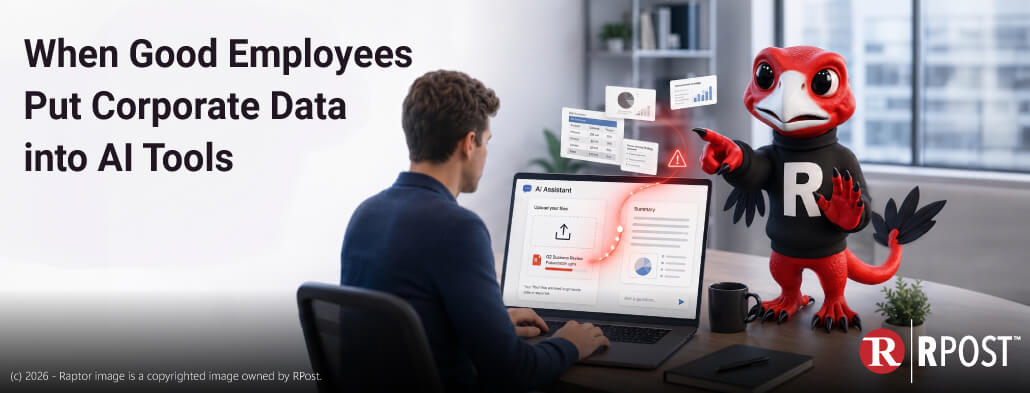
Rocky the Raptor here, RPost’s cybersecurity product evangelist. Recently, I shared a PowerPoint presentation containing strategic company information with a small group of trusted colleagues. The presentation covered future plans, market opportunities, competitive positioning, and other sensitive topics that executives routinely discuss inside well-run organizations. The audience consisted of some of the smartest people in the company, and everyone who received the presentation was authorized to review the material.
A few days later, I came across an email thread containing a summary of the presentation, which was excellent! In fact, it was almost suspiciously good. The structure was flawless, the language was polished, and the distillation of key points was remarkably efficient. Having spent enough time around generative AI systems, I immediately recognized what I was likely reading.
The person who wrote the summary did not have a company-approved AI account. That led to an uncomfortable realization. In all likelihood, the PowerPoint had been uploaded into a personal AI account to generate the summary. The employee was not acting maliciously; quite the opposite. The individual was trying to save time, improve productivity, and help colleagues absorb information more efficiently. Yet in doing so, a much larger issue emerged.
Before an AI system can summarize a presentation, it must first ingest and understand it. Every slide, chart, financial assumption, strategic discussion point, and piece of context must be processed by the model before it can produce a useful output.
Most people focus on the summary that comes out of the AI system, while a few stop to consider what had to happen first for that summary to be created. This issue is becoming increasingly common across enterprises.
Executives are now seeing AI-generated meeting summaries that are too detailed to have been created manually. Virtual meeting assistants silently join conference calls and produce comprehensive recaps. Employees upload spreadsheets, presentations, pricing models, contracts, and planning documents into AI tools because doing so helps them work faster. In most cases, these employees are acting with the best intentions. But unfortunately, good intentions do not eliminate risk.
The challenge is that once sensitive information leaves an organization's controlled environment and enters an external AI ecosystem, visibility and control become significantly more difficult. Organizations may not know where the information is stored, how long it is retained, what security controls protect it, or what future systems may gain access to it.
The issue is not necessarily whether an AI provider trains future models using the information. The larger concern is that the organization has lost direct control over some of its most valuable intellectual assets.
This creates a new category of insider risk. Historically, organizations focused on malicious insiders who intentionally stole or leaked information. Today, a growing percentage of information exposure may originate from employees who are simply trying to become more productive. The modern information leak often begins not with criminal intent, but with a request to "summarize this presentation," "extract key insights," or "help me prepare talking points."
The challenge becomes even greater when sensitive information is shared outside the organization. Imagine providing a confidential pricing list to a partner, a strategic roadmap to a reseller, or a business plan to an advisor. Even if those recipients are trustworthy, there is no practical way to know whether someone on their side will upload the content into a personal AI assistant for convenience. Once that happens, the information has effectively entered an environment beyond the original owner's visibility and control.
This reality forces organizations to rethink a long-held assumption about document sharing. For decades, businesses have relied on file formats such as PowerPoint, PDF, Word, and Excel because they are universally accessible. The problem is that they are also universally readable by AI systems. What was once merely a document has become machine-readable fuel for AI engines.
As AI adoption accelerates, organizations may need to shift their thinking from securing networks and endpoints to securing the content itself. The critical question is no longer simply who can receive a document. The more important question is who, or what, can read and process it once it arrives.
That realization has changed how I think about sharing sensitive information. Going forward, I increasingly prefer sharing highly sensitive content in Rights Protected Document (RPD) format using RPost's RDocs platform.
Unlike conventional file formats, Rights Protected Documents are designed for human consumption while maintaining meaningful control over how content is accessed and used. Recipients can view the information easily through their browser, much like they would view a PDF, but the content remains protected in ways that reduce the risk of uncontrolled AI ingestion.
The broader lesson extends far beyond any particular technology. The AI revolution is creating enormous productivity benefits for businesses, but is simultaneously creating a new form of information leakage that many organizations have not fully considered. Sensitive meetings, presentations, pricing information, strategic plans, and proprietary research are increasingly being fed into AI systems by well-intentioned employees who simply want to work more efficiently.
In the past, organizations worried about competitors obtaining confidential information. Today, they must also consider whether that information is being continuously exposed to AI systems operating outside their governance framework. As businesses race to embrace AI, they should remember a simple principle: just because an AI system can read a document does not mean it should.
In the years ahead, protecting content from unintended AI exposure may become just as important as protecting it from hackers, malware, or malicious insiders. And companies that recognize this shift early will be better positioned to enjoy the benefits of AI without inadvertently giving away the very information that makes them valuable.
October 23, 2026

October 16, 2026

October 09, 2026
October 01, 2026
September 25, 2026





 Blog
Blog