





The cybercriminal targeting your company may not be trying to break into your network. He may already be inside the mailbox of your lawyer, supplier, accountant, or other trusted adviser. From there, the attacker can quietly read your messages, study your documents and learn how your organization works.
No malware needs to detonate on your endpoint, and no suspicious email needs to cross your gateway. The criminal simply watches.
Hey, Rocky the Raptor here, RPost’s cybersecurity product evangelist. Welcome to cybersecurity’s Spy vs. Spy era. And the prize is context - who approves payments, when a deal will close, which executive is traveling, how a partner writes, and what a customer expects next. Once attackers have enough context, they can create the email, call or web-meeting impersonation most likely to succeed.
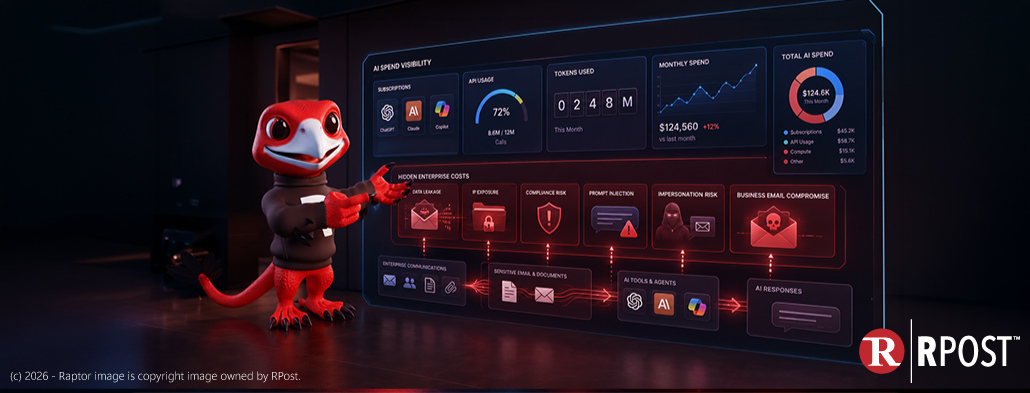
A person inside a compromised mailbox might search for “wire,” “invoice” or “confidential.” A rogue AI agent can read years of correspondence, map business relationships, summarize attachments, identify high-value transactions and monitor new conversations around the clock. It can not only learn what your company is doing, but also how your people speak about it.
That matters because the next generation of deepfakes will depend as much on context as on synthetic audio or video. A cloned voice is far more convincing when the caller knows the transaction amount, the advisers involved, and why the request is urgent. A lookalike email is harder to spot when it refers to a real document and arrives at the exact moment instructions are expected.
The eventual attack may enter through email, but its intelligence was collected elsewhere.
A healthcare security executive recently summarized the answer neatly: “Better to PRE-Crime than POST-Crime.” Most cybersecurity operates in POST-Crime time. A payment is diverted, credentials are used or files are encrypted. Then the incident team determines what happened and tries to limit the damage. PRE-Crime starts earlier; it looks for the reconnaissance that makes the crime possible.
That means finding a way to spy on the spies spying on your content. Though the concept sounds circular, it’s not. An attacker observes your communications while your security system quietly observes the attacker’s interaction with those communications. But the watcher may reveal technical breadcrumbs - network origin, hosting infrastructure, device characteristics, application behavior, geography, timing, and access patterns.
A single breadcrumb proves little. Security scanners, cloud proxies, and legitimate travelers can all look unusual, but their patterns differ. The same device inconsistency may recur across multiple messages, similar infrastructure may appear around unrelated recipients, content may be accessed from an implausible sequence of locations, or activity may repeatedly cluster around high-value transactions. Each event may appear green, but together, they can form a cybercriminal fingerprint.
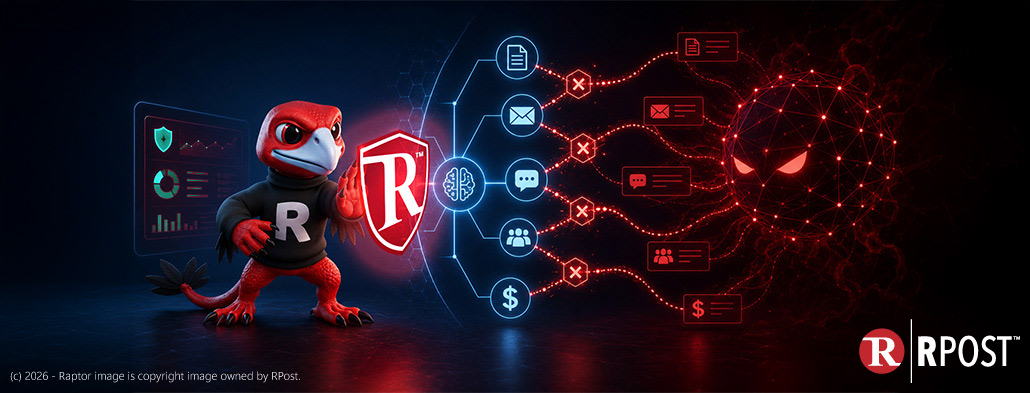
That is the counterintelligence premise behind RPost’s RAPTOR™ AI. RAPTOR uses authorized interaction with protected email, documents, and shared content to detect suspected reconnaissance beyond the organization’s endpoints. It correlates otherwise weak signals, develops fingerprints, and hunts for related activity across first- and third-party environments. This is not hacking back. RAPTOR does not need to enter the attacker’s system; it turns the attacker’s interaction with your own content into intelligence.
The next step is more important: stop feeding the spy. When credible risk emerges, RAPTOR can work with RPost’s AI Auto-Lock™ and Double DLP™ controls to pause, restrict, or revoke access to protected content after it has been sent. Think of this as un-leaking the leak.
You cannot make an adversary forget what has already been read. But you can prevent the adversary from collecting the next document, the next instruction, or the final piece of context needed to execute the crime.
Kill the context, and you may kill the attack it was building. This matters because conventional security controls largely watch environments the organization manages. For instance, email gateways inspect messages, endpoint tools monitor devices, identity systems examine authentication, and SIEM platforms collect available logs.
Traditional DLP decides whether information should leave. These systems may have little visibility into a compromised mailbox at a law firm, title company, supplier, or customer.
RAPTOR asks a different question: What is happening to our information after it reaches an environment we do not control? That makes it additive to email security, EDR, identity protection, SIEM and DLP -- not a replacement for them.
Cybercriminals are already using AI to absorb more information, identify better targets and create more credible impersonations. Legitimate AI agents are also gaining access to business communications, sometimes with more authority than their owners understand. The defender needs an intelligence advantage of its own.
Watch the watchers, record their fingerprints, hunt the related activity, deny the context, preempt the attack - that is PRE-Crime cyber counterintelligence.
July 31, 2026
July 24, 2026

July 17, 2026
July 10, 2026

July 03, 2026





 Blog
Blog