




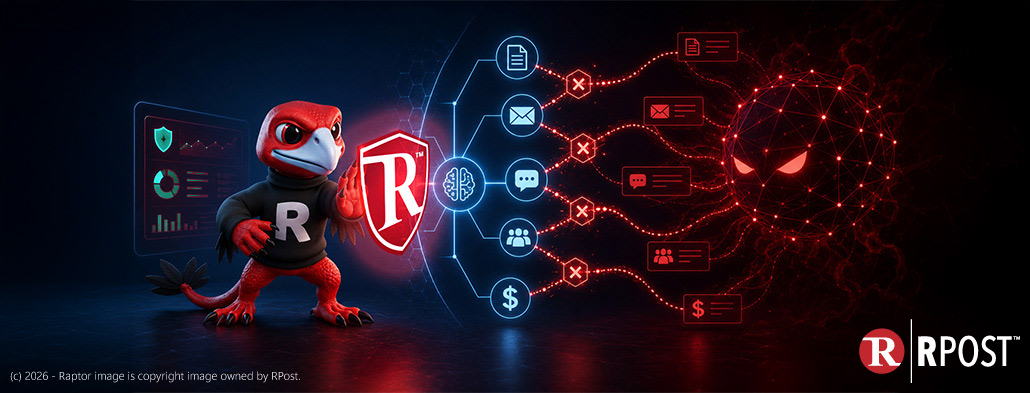
Rocky the Raptor here, RPost’s cybersecurity product evangelist. For years, cybersecurity strategy centered on one objective -- keep the bad guys out by building stronger firewalls, blocking phishing emails, detecting malware, and responding quickly when something slipped through.
That model still matters, but it no longer reflects how modern cybercrime works.
Traditional security often tells you that something happened. Cyber resilience seeks to reduce the business impact after it happens. In many cases, that means detecting reconnaissance early enough to lock content, restrict access, preserve evidence, and prevent sensitive information from becoming the foundation for a successful fraud campaign.
DarkAI has accelerated the need for this shift. As cybercriminals use AI to automate reconnaissance, enterprises must use AI to automate resilience. The competition is increasingly AI versus AI, with the outcome determined not by who reacts fastest, but by who identifies intent first.
The rise of DarkAI -- artificial intelligence used by cybercriminals to automate reconnaissance, deception, and fraud -- is fundamentally changing the conversation. Today's attackers don't simply launch attacks; they first study their targets. In fact, the attack often begins weeks before the first fraudulent email is ever sent.
Cybercriminals will compromise third-party accounts and devices, those often with fewer cybersecurity resources or awareness than you and your team. AI agents then quietly analyze business relationships, monitor transaction patterns, identify key decision makers, and gather the context needed to create highly convincing business email compromise, supplier impersonation, and payment fraud schemes.
This is precisely why cybersecurity is evolving into cyber resilience.
Gartner increasingly frames resilience around operational visibility, accountability, integrated compliance, and continuous monitoring. Deloitte emphasizes business continuity, third-party risk, and recovery.
Accenture expands resilience beyond incident response to include an organization's ability to continue operating during disruption.
Aragon Research adds another important perspective, arguing that documents, communications, and digital transaction content have become prime targets for cybercriminal reconnaissance, requiring what it calls Preemptive Intelligent Content Security.
The common thread is clear: prevention alone is no longer enough.
Today's greatest risks often emerge after sensitive information leaves the enterprise, such as contracts moving to outside counsel, pricing lists being shared with partners, financial reports traveling to auditors, purchase orders, invoices, and transaction documents flowing through suppliers and customers whose security environments you do not control.
This is where resilience becomes operational rather than theoretical.
Rather than asking only whether a document was securely delivered, organizations increasingly need to ask whether it was later accessed via suspicious infrastructure, whether a recipient's account was compromised, whether cybercriminals are conducting reconnaissance, and whether sensitive content can still be controlled BEFORE it is weaponized.
It’s where RPost has built a differentiated approach.
Instead of replacing existing security investments, RAPTOR™ AI extends visibility beyond the enterprise perimeter. It transforms outbound communications into a source of threat intelligence, identifying suspicious interaction patterns, compromised third-party environments, and early reconnaissance activity before attackers turn business context into financial loss.
At the same time, technologies such as AI Auto-Lock™, Double DLP™, Registered Email™, Registered Encryption™ and Rights Protected Documents enable organizations to not just detect exposure, but also contain it - even after content has left the organization.
This is an important distinction.
RPost complements existing security platforms by adding capabilities that strengthen operational resilience where many attacks actually develop:
DarkAI is changing the economics of cybercrime. The organizations that succeed will not simply prevent more attacks; they will detect sooner, contain faster, prove more clearly, and continue operating with confidence when attacks inevitably occur.
That is the essence of cyber resilience, and why it is quickly becoming the new measure of enterprise security. Contact us to learn more about RPost’s preemptive cybersecurity tech, a foundation of Cyber Resilience.

October 16, 2026

October 09, 2026
October 01, 2026
September 25, 2026

September 18, 2026





 Blog
Blog