



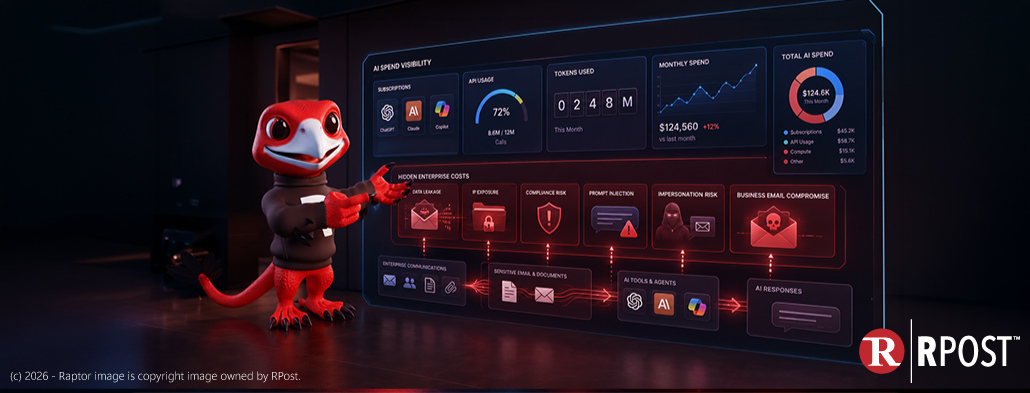
Ask a CFO what AI costs and you'll probably get an answer measured in subscription fees, API consumption, or monthly token budgets - $20 a month for an individual assistant, enterprise licenses for Microsoft Copilot or Claude, or API charges based on tokens consumed.
For development teams building AI agents, discussions quickly become technical, comparing context windows, inference pricing, and model performance. Those are all useful metrics, but they may be the least important costs in the AI equation.
Hey Rocky the Raptor here, RPost’s cybersecurity product evangelist. I was just reading in PitchBook about an interesting paradox they highlighted in the frontier AI market. Models that appear expensive on a per-token basis often complete business tasks more efficiently than lower-cost alternatives because they require fewer retries, less prompt engineering, and less human intervention. In other words, the cheapest AI isn't always the least expensive AI.
That observation says something much larger about enterprise AI adoption. Organizations are becoming increasingly sophisticated at measuring the direct cost of AI while remaining remarkably poor at measuring its indirect cost.
Instead, it appears months later as pricing competitive disadvantage, litigation exposure, intellectual property leakage, regulatory scrutiny, or a business email compromise that seemed to come out of nowhere.
Every day, employees paste valuable business context into AI systems with entirely good intentions. For example, pricing models are uploaded to prepare customer proposals, discount schedules are summarized for sales teams, litigation strategies are refined before meetings with outside counsel, board presentations are shortened into executive briefs, product roadmaps are turned into marketing copy, source code is reviewed, acquisition plans are analyzed, security architectures are explained so an AI can recommend improvements, and many more.
None of those employees believe they are leaking confidential information. Most believe they are simply becoming more productive.
Yet the quality of an AI response is directly proportional to the quality of the context it receives. The more strategically valuable the information, the more useful the AI becomes. That creates a governance problem that many organizations still underestimate. Enterprises invest heavily to protect information inside their own environments, only to have employees voluntarily submit that same information to consumer AI platforms or personal AI subscriptions that may use customer interactions to improve future models or otherwise retain organizational knowledge under their own published terms of service.
And, then there is the unknown about how your third-party recipients drop your sensitive content into their shadow AI! (By the way, the best way to control your content from AI-era eavesdropping even at third parties is with RDocs)
Across enterprises, AI agents are being connected to Microsoft 365, Google Workspace, Teams, Slack, CRM platforms, ERP systems, and corporate email so they can quietly automate administrative work, monitor communications, summarize meetings, draft responses, and execute routine business processes.
For CIOs, the productivity opportunity is obvious. Less obvious is the fact that every new AI agent becomes another privileged participant inside the enterprise.
Unlike a human employee, an AI agent never sleeps, reads everything it has permission to access, and responds instantly to instructions. That makes prompt injection one of the more important emerging threats in enterprise security.
Hidden instructions embedded inside an email, document, or collaborative workspace can influence how an AI agent behaves, potentially causing it to recommend fraudulent payments, expose sensitive information, or assist in highly convincing impersonation attacks. Business email compromise no longer requires stealing an executive's credentials if an attacker can manipulate the trusted digital assistant operating inside the executive's communications.
The important questions are no longer simply whether employees are using AI, but how they are using it. What information is routinely entering AI prompts? Which departments rely on consumer AI services? Which AI agents have access to executive communications? Where is confidential information leaving approved workflows? Which business decisions are increasingly influenced by AI-generated recommendations?
These are governance questions, not technology questions.
Recognizing that shift, and the fact that many AI governance platforms miss analyzing email, RPost recently introduced its RAPTOR™ AI Observability capability for email communications, extending visibility into an area often overlooked by browser monitoring, API governance, and application security tools. Email remains the primary vehicle through which organizations exchange their most valuable business context, making it one of the most important places to understand where AI is participating, where sensitive information may be exposed, and where governance controls should begin.
Artificial intelligence will almost certainly become as fundamental to knowledge work as email itself. The organizations that benefit most will not necessarily be those that buy the most powerful models or negotiate the lowest token prices. They will be the ones that understand the full economics of AI balancing productivity with governance, automation with oversight, and innovation with resilience.
The monthly subscription is easy to measure; the token bill is easy to audit. But the strategic cost of unknowingly teaching the world your business may be far harder to recover from. That is the cost of AI that deserves a place on every CIO's dashboard.

October 09, 2026
October 01, 2026
September 25, 2026

September 18, 2026
September 16, 2026





 Blog
Blog