




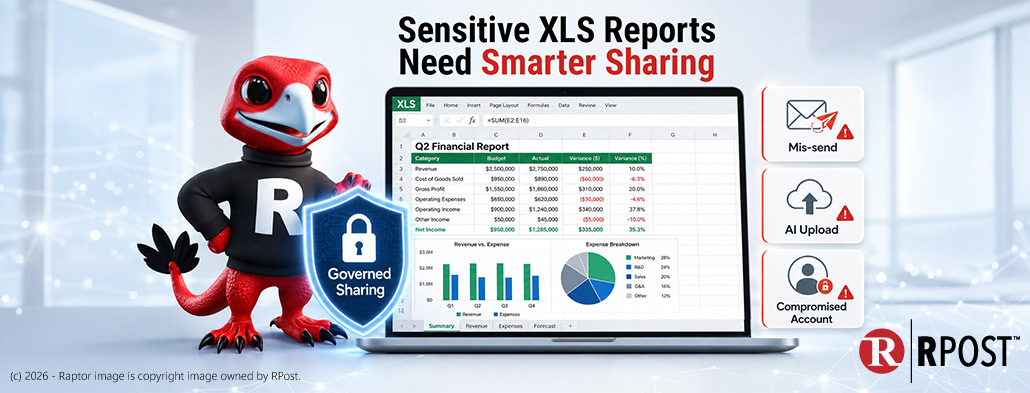
Rocky the Raptor here, RPost’s cybersecurity product evangelist. I’ve been thinking; there are a few file formats in business that have become so familiar that executives rarely pause to question them. The spreadsheet is one of them.
For decades, XLS and its newer spreadsheet cousins have been the default containers for financial models, customer lists, debt schedules, asset registers, pricing tables, shareholder rolls, budget forecasts, compensation analyses, and almost every other structured dataset that quietly defines how a business operates.
The familiarity is exactly the problem! A spreadsheet is rarely just a spreadsheet. It is often a compact, sortable, filterable treasure chest of confidential business intelligence. One accidental mis-send, compromised laptop, careless forward, or one upload into an unmanaged AI tool can expose a lot of competitive and operational intelligence than a thousand-page report ever would.
A PDF may reveal a conclusion, but a spreadsheet often reveals the assumptions, relationships, formulas, priorities, and the leverage points behind the conclusion.
This is why the question is no longer whether spreadsheets are useful; rather, why any organization would continue to share highly sensitive XLS reports in a format that was never designed for the modern threat environment.
The old model assumed that once a file was sent securely, the risk was largely over. That assumption no longer holds. RPost’s recent cybersecurity insights make the point clearly: risk often begins after delivery, when content moves into third- and fourth-party environments where attackers, careless insiders, unmanaged AI tools, and compromised devices may all have access. RPost describes this as the need to see and protect content beyond the endpoint and beyond the network, using intelligence generated from how content is accessed and used after it leaves the organization.
For spreadsheet reports, this matters enormously. Consider what typically lives inside them: pricing strategies, margin structures, investor records, banking details, receivables, payables, M&A target lists, loan schedules, customer renewal forecasts, reseller discounts, insurance portfolios, claim reserves, payroll planning, and client asset allocations. These are not merely documents, but operating maps. In the hands of a competitor, they are market intelligence, but in the hands of a cybercriminal, they are reconnaissance gunpowder.
This is especially true in the age of AI-enabled attacks **AND** in the age of a recipient of your XLS dropping it into a personal AI model (Claude, ChatGPT, etc.) that then makes your data and formulas effectively open source - available for any future third-party query and never erasable from the open AI global knowledge base. UGH!!!
A leaked spreadsheet no longer needs to be manually reviewed by a human adversary. It can be ingested, summarized, cross-referenced, and weaponized by AI systems almost instantly. A cybercriminal does not need to understand your business deeply if your spreadsheet does the explaining for them. The data can identify who matters, where the money moves, which clients are valuable, which transactions are imminent, and which relationships can be exploited.
That is why the traditional XLS attachment is starting to look like an artifact from another era. It delivers convenience at the expense of control, preserving usability, but not governance. It gives recipients everything they need, while also giving any unintended recipient or compromised environment the same advantage.
RPost’s RDocs advances this discussion significantly. Historically, organizations faced an awkward trade-off. They could share spreadsheets in native XLS format and preserve usability, but lose meaningful downstream control. Or they could convert spreadsheets into static protected formats and preserve control, but lose the ability to filter, sort, and manipulate the data in ordinary business ways.
That trade-off is now changing. With the Rights Protected Document format for XLS, RDocs preserves the advantages that made it compelling in the first place - no third-party storage requirement, no separate viewer application, and protection embedded into the content experience itself. At the same time, it allows recipients to retain basic spreadsheet usability, including filtering, sorting, and other practical data manipulation needed for business review.
This is not a cosmetic improvement; it is a structural change in how sensitive spreadsheet data can be shared.
The significance is easiest to understand through the lens of confidential computing. The cybersecurity industry has long focused on protecting data at rest and in transit. The harder problem is protecting data while it is being used.
Gartner and others have elevated this concept because it addresses a reality every business now faces: sensitive information is most vulnerable not only when stored or sent, but when opened, reviewed, analyzed, and acted upon. RPost’s recent commentary similarly frames this as intelligent security in the content itself, rather than dependence solely on the network around it.
RDocs brings that idea to one of the most dangerous file types in business. It allows organizations to share sensitive spreadsheet reports in a way that supports practical review while reducing the uncontrolled exposure that comes with native XLS files. This is the difference between sending a file and sending governed content.
It also aligns with where analysts see the market moving – from reaction to preemption. As a matter of fact, Gartner Research named RPost an Innovator and Visionary in its Pre-Crime Preemptive Cybersecurity Impact Radar report and included RPost in its Magic Quadrant for Email Security Platforms and Critical Capabilities for Email Security reports (see accolades).
Aragon Research has also described this emerging category around preemptive intelligent content security, naming RPost as a Pioneer. The common theme is that protection must move closer to the content itself because the enterprise perimeter is no longer where business information lives.
This is not just a cybersecurity issue. It is an issue of governance, competitive intelligence, and increasingly a board-level issue. Executives should assume that any sensitive spreadsheet shared in ordinary XLS format may eventually be forwarded, copied, uploaded, ingested, or compromised. They should also assume that if the data is valuable enough to prepare, analyze, or distribute, it is valuable enough for someone else to misuse.
The spreadsheet will not disappear from business. It is too useful, too embedded, and too powerful. But the habit of sharing sensitive spreadsheets as ordinary XLS attachments should begin to fade quickly. The risks are too obvious, the downstream visibility too weak, and the value of the exposed data too high.
The better question for executives is not whether spreadsheet reports should be protected. It is why they have been shared unprotected for so long.
In the AI era, the XLS attachment is no longer just a convenience but a liability. With RDocs Rights Protected Document format for XLS, organizations can preserve the business utility of spreadsheet data while placing intelligent security into the content itself. That is where this market is heading, and for sensitive reports, it may soon become the only defensible way to share.
This is a new business feature in RDocs; contact RPost to enable it. Advanced CAD File viewing is coming next!

October 09, 2026

October 01, 2026

September 25, 2026

September 18, 2026
September 16, 2026





 Blog
Blog