




There’s a familiar rhythm in technology cycles. Something new emerges, gains traction among developers and early adopters, and almost overnight the narrative escalates from “this is
useful” to “this replaces everything that came before it.”
Hey, Rocky the Raptor here, RPost’s cybersecurity product evangelist, and today we’re watching that happen right now with MCP servers. If you’ve spent any time around AI, developer circles, or enterprise tech conversations lately, you’ve likely heard some version of the claim: APIs are dead.
Let me tell you – they ARE NOT.
But something meaningful is also happening underneath the noise, and it’s worth understanding, especially if you’re running a business, investing in technology, or thinking about how your organization will operate in an AI-driven world.
Let’s start with clarity.
API, or Application Programming Interface, is simply a structured way for one system to talk to another. It defines rules, endpoints, and expected inputs and outputs. For decades, APIs have been the backbone of how software integrates.
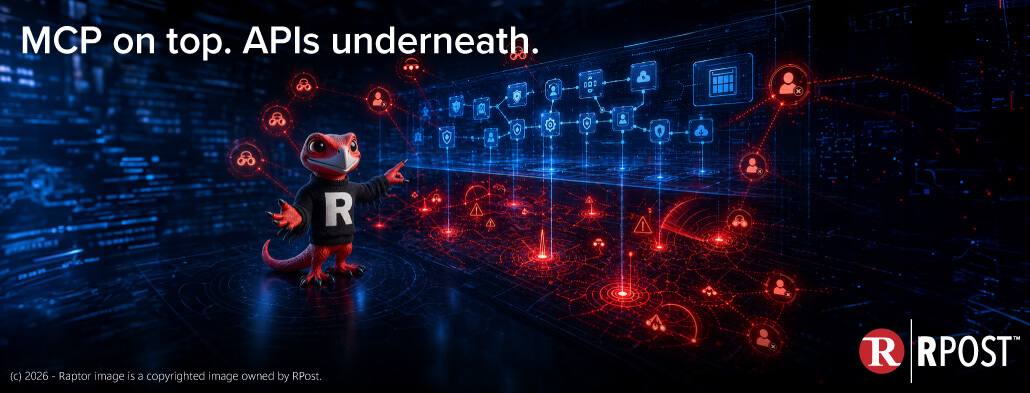
An MCP server (Model Context Protocol server) doesn’t replace that. Instead, it sits one layer above it. Think of it as a universal translator and coordinator for AI systems. Rather than requiring a developer to write code that says, “call this API with these parameters,” an MCP-enabled system allows an AI agent to interpret a higher-level instruction; something like “Get this contract signed, send it securely, and lock down related documents.” The MCP server then determines which systems to use, which APIs to call, and in what sequence.
But underneath it all, APIs are still doing the work. The MCP layer simply abstracts that complexity away from the human operator. A helpful way to think about it: APIs are the wiring inside the walls. MCP servers are the control panel that lets you operate everything without seeing the wiring.
The reason MCP is generating so much excitement isn’t that it replaces APIs. It’s because it changes who interacts with them and how.
Historically, integration has been a developer-heavy task. Systems didn’t naturally talk to each other. Every connection required planning, coding, testing, and maintenance. Businesses invested heavily in integration layers, middleware, and teams whose primary job was to make systems cooperate.
Now, with AI agents layered on top of MCP-like standards, that process becomes far more fluid. Instead of building rigid connections, organizations can describe intent and let AI handle execution across systems.
That’s a real shift. It reduces friction, accelerates workflows, and lowers the barrier to automation. But it doesn’t eliminate APIs. It simply moves them down the stack.
If something is fading, it’s not APIs. It’s the way we’ve been forced to use them. Custom, one-off integrations - the kind that require bespoke engineering for every application pairing - are becoming less necessary. So are user interfaces built purely to bridge gaps between systems.
Even certain categories of middleware providers - those whose core value lies in translating between APIs - may find their role diminished as standards like MCP become more widely adopted. In other words, what’s changing is not the existence of APIs, but the cost and complexity of connecting them.
That’s a significant evolution, but it’s not extinction; it’s maturation.
This transition aligns closely with what RPost defines as its first AI pillar: Intelligent Workflows. The idea is straightforward but powerful. Instead of humans coordinating tasks across systems - logging into one platform, exporting data, importing it into another, sending emails, tracking status - AI agents take on that role. They act as operators, executing multi-step processes across applications based on simple instructions.
Within RPost’s ecosystem, this can look like a contract being routed through RSign for signatures, automatically delivered via RMail with encryption and compliance controls, and then associated with related files in RDocs - all without manual intervention.
This is the promise of MCP-enabled workflows: fewer steps, fewer errors, faster execution.
But here’s the important nuance. While this capability is powerful, it is also rapidly becoming expected. Major platforms are moving in the same direction, and intelligent workflows are likely to become table stakes.
The second pillar, Intelligent Content, builds on this foundation. It reflects a shift in how we think about documents, emails, and files. Instead of being static assets, content becomes responsive. It understands context, triggers actions, and enforces policies based on what it represents.
This has meaningful implications for productivity and compliance. A document can initiate a workflow, a message can enforce security controls, and a file can adapt its accessibility based on its sensitivity or relevance.
Over time, this layer makes systems more intuitive and reduces the need for manual oversight. It also strengthens customer retention by embedding intelligence directly into the tools people use every day.
But again, this is an area where the broader enterprise software market is investing heavily. It contributes to product differentiation and ongoing innovation, but it is not, by itself, a new category.
While much of the industry is focused on connecting systems and making workflows more efficient, a more consequential shift is happening elsewhere with far greater implications for business risk and enterprise value.
That shift is captured in RPost’s third pillar: Intelligent PRE-Crime Cybersecurity. This is where the conversation moves beyond automation and into prevention.
Traditional cybersecurity tools are designed to detect threats once they reach the enterprise perimeter - malware on a device, suspicious activity in a network, unauthorized access attempts. They operate within boundaries that organizations control.
But modern attacks increasingly originate outside those boundaries. They unfold across third-party systems, compromised accounts, and extended networks where visibility is limited or nonexistent.
RAPTOR™ AI addresses this gap by creating a new layer of insight. It generates and analyzes forensic interaction metadata - data derived from how content is accessed, shared, and used AFTER it leaves the organization.
This type of data doesn’t exist in conventional security systems. It can’t be reconstructed from logs or endpoints, and only becomes visible when security is embedded at the content layer itself. With that visibility, RAPTOR AI can identify early indicators of risk:
It shifts the focus from reacting to attacks to anticipating them.
The distinction here is important. MCP servers and intelligent workflows improve efficiency. They make organizations faster and more connected, while intelligent content makes systems more adaptive and user-friendly.
But PRE-crime cybersecurity changes the equation entirely. It connects the technology directly to financial outcomes by preventing high-impact events before they occur.
In an environment where attacks are increasingly subtle, distributed, and premeditated, that capability becomes not just valuable, but essential.
The current narrative around MCP versus APIs is, in many ways, a distraction. It focuses on the mechanics of integration rather than the strategic implications of what those integrations enable.
Indeed, MCP servers will likely become standard, but APIs will remain foundational. The real question is not how systems connect, but what organizations can do and prevent, once they are connected. That’s where the next wave of differentiation lies.
As businesses adopt AI-driven workflows and embrace new standards like MCP, the underlying infrastructure will become less visible, integration will feel easier, and automation will feel natural. But as complexity increases and data flows more freely across systems and partners, risk expands in parallel.
Organizations that succeed will not be those that simply connect their systems more efficiently; rather, the ones that understand and manage the new risks those connections create.
That is where RAPTOR AI’s third pillar quietly becomes the most important, not because it replaces anything that came before, but because it addresses something that hasn’t been solved until now.

October 09, 2026

October 01, 2026

September 25, 2026

September 18, 2026
September 16, 2026





 Blog
Blog