


Rocky the Raptor here, RPost's Cybersecurity AI Product Evangelist. I've been watching how the business of cybercrime is evolving, and this week's headlines offer a striking example. What does a potential $6.3 billion cryptocurrency heist tell us about the future of cybercrime? Quite a lot, apparently.
On October 30, Binance reported a major security incident, with preliminary findings pointing to a compromised DevOps engineer's laptop that may have enabled unauthorized withdrawals. The estimated impact stands at $6.3 billion, although approximately $3 billion in affected assets had already been frozen when Binance issued its update. The investigation is still ongoing.
The incident is a striking reminder of the enormous financial stakes in modern cybercrime. But there's a bigger story here, one that goes well beyond cryptocurrency.
For years, ransomware operators made their money by using cryptography to lock up systems and demand payment. That business remains active, but cybercriminals are increasingly exploring other ways to profit. Data theft, extortion without encryption, compromised accounts, and direct cryptography-targeted cryptocurrency theft offer additional ways to turn unauthorized access into money.
In fact, Google Threat Intelligence's March 2026 analysis suggests that declining ransomware profitability may push some criminals toward alternative ways to monetize stolen access, including data extortion. The message? Criminals are following the money, and they're getting better organized in the process.
Welcome to Cybercrime Inc.- the global criminal enterprise where stealing your money is everybody's business.
Forget the lone hacker sitting in a dark basement. Today's cybercrime operations increasingly resemble international businesses, complete with specialized departments, software suppliers, contractors, financial intermediaries, and AI-powered workers.
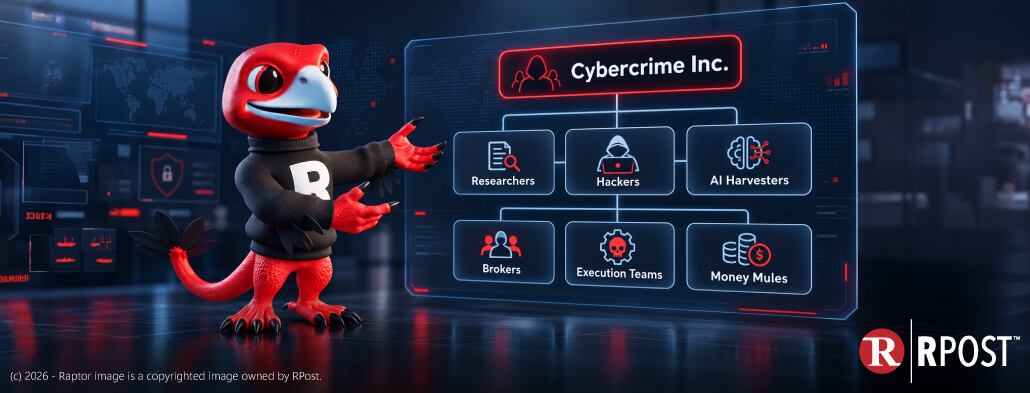
The interesting part is that the people running these different operations may never have met one another. Some sell services, others purchase intelligence, and still others specialize in turning stolen access into stolen money. Here's what their organizational chart might look like:
One group may conduct the research, another compromises an account, a third analyzes the correspondence, and a fourth executes the fraud. Everyone has a specialty. Everyone wants a share of the profits. Cybercrime Inc. has effectively developed its own international supply chain!
Now comes the part that should concern more than just cybersecurity professionals.
Imagine accepting a remote bookkeeping job. The employer appears legitimate, the interview goes smoothly, and the responsibilities sound familiar: receive payments, maintain financial records, and pay vendors.
The work seems routine. Except some incoming funds may represent proceeds from fraud, while the supposed vendors receiving payments may actually be part of a criminal money-laundering network. The bookkeeper thinks they're managing accounts payable. Cybercrime Inc. sees a useful financial intermediary.
The FBI has repeatedly warned about criminals recruiting unsuspecting people through legitimate-looking employment opportunities to receive and transfer stolen funds. Some participants knowingly assist criminals. Others are deceived into believing they're performing legitimate work. In more extreme cases, people are coerced into participating in criminal operations.
And this is far from a small-scale problem. In its March 2026 Global Financial Fraud Threat Assessment, INTERPOL described increasingly organized international criminal networks collaborating with specialized money-laundering groups, sharing expertise, and using AI to expand their operations. The report also highlighted the growth of industrial-scale scam centers, including operations involving people who have been trafficked and forced to commit fraud.
That's the disturbing part: Cybercrime Inc. doesn't need every employee to know they're working for criminals.
The international division of criminal labor isn't new. What's changing is how quickly and cheaply these operations can now function. AI can help criminals identify valuable targets, analyze compromised correspondence, generate convincing impersonations, translate communications, and automate repetitive tasks. It can also lower the expertise required to participate in sophisticated fraud.
Consider a compromised supplier mailbox. Historically, an attacker might have spent considerable time reading correspondence to understand the supplier's customers, invoice formats, and payment schedules. Now, AI-assisted analysis can help identify those patterns much faster. The information can then be passed to another criminal who specializes in executing payment fraud.
The attacker sending the fraudulent invoice may know remarkably little about the victim's organization personally. But the intelligence collected and analyzed by others could make the impersonation extremely convincing.
For businesses, that changes the threat equation. The danger is no longer limited to someone sending a suspicious email. Criminals may already understand who your organization trusts, how payments are authorized, and when a particular transaction is expected.
We're entering an AI-vs.-AI world, and Cybercrime Inc. is investing in its own AI workforce.
Here's the problem for businesses. Your systems may be secure, your employees may be vigilant, your email gateway may be successfully blocking malicious messages, and your security dashboard may show nothing particularly alarming. Meanwhile, an important supplier's mailbox has been compromised.
Criminals could be quietly monitoring legitimate conversations, learning how your organization operates, identifying upcoming transactions, and preparing to impersonate someone your finance team already trusts.
Your organization could be the ultimate target even though the original intrusion happened somewhere else. And when the fraudulent payment instruction finally arrives, it might come from a familiar email address, within an existing conversation, using language that closely resembles previous exchanges. That's why focusing only on the final attack can leave a dangerous gap.
The Binance incident illustrates the importance of understanding how unauthorized access can lead to financial exploitation, although its specific compromise is different from the business email threats discussed here. For enterprise security leaders, the broader lesson is to look beyond the immediate attack and consider what criminals may have been doing beforehand.
These are the kinds of questions that traditional endpoint and email security controls may not fully answer.
That's where RPost's RAPTOR™ AI PRE-Crime™ Cyber Counterintelligence comes in. By analyzing forensic signals from email and shared-content interactions, RAPTOR AI can help identify suspicious eavesdropping, unexpected access patterns, and indicators of potential third-party compromise.
The objective is to reveal signs of reconnaissance while criminals may still be studying a business relationship, giving organizations an opportunity to investigate and take protective action before that intelligence is exploited.
In today’s era of rapid AI cybercriminal agent speed, post-crime defense may be too late. Binance had all the post-crime cyber defense tools, yet the crypto thieves prevailed. You need to pre-empt. PRE-Crime™ style (think RPost RAPTOR™ AI). It’s better to defend PRE-Crime, after all, than scramble POST-Crime.
This complements traditional cybersecurity controls. Rather than relying exclusively on detecting malicious messages or investigating fraud after it occurs, organizations can gain visibility into certain suspicious activities that may precede the attack. And remember, the fraudulent payment is often just the final step in a much longer operation.
Cybercrime Inc. has gone global. It has researchers, hackers, brokers, software providers, financial intermediaries, unwitting recruits, and an increasingly AI-powered workforce. As criminal business models evolve, the same underlying problem remains: attackers profit from the access, information, and trust they can exploit.
For enterprises, protecting business communications now requires thinking beyond the security of individual systems and considering the wider network of relationships through which sensitive information travels. The lesson isn't simply to prepare for the next attack. It's to recognize suspicious activity while criminals are still preparing.
Find the spies before they become the thieves. That's PRE-Crime. That's RAPTOR AI.

November 13, 2026

November 06, 2026
October 30, 2026

October 23, 2026

October 16, 2026


 Blog
