




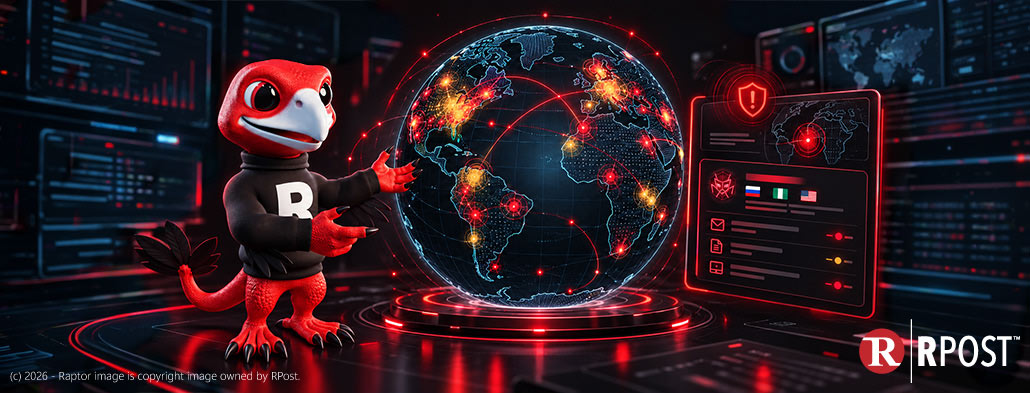
Rocky the Raptor here, RPost's cybersecurity product evangelist. I've been thinking about spies lately. Not the ones in dark sunglasses exchanging briefcases on park benches, but the ones quietly operating inside compromised email accounts, studying business conversations, learning who trusts whom, and waiting for the right moment to strike.
Consider this. The cybercriminal preparing to impersonate your company's CEO may already be reading your emails. Not from your mailbox, but from the compromised account of your lawyer, supplier, or trusted business adviser.
With rogue AI agents doing much of the intelligence gathering, attackers no longer need to spend weeks manually reading correspondence. DarkAI can analyze large volumes of communications, map business relationships, identify upcoming transactions, and learn when and how to impersonate someone you trust.
By the time a convincing payment request or fraudulent invoice arrives, the attacker may already know enough about your business to make it look completely legitimate.
This is one of cybersecurity's most consequential blind spots. Traditional cybersecurity has largely focused on recognizing malicious messages, blocking suspicious activity, and responding when something goes wrong. Those defenses remain essential, but they don't always reveal the intelligence gathering that precedes an attack.
There may be no suspicious attachment, no obvious phishing link, and no malware to detect. The attacker is simply watching, learning, and preparing. Much of this activity may happen outside the organization's managed network, where conventional cybersecurity tools have limited visibility.
This is where cybersecurity begins to resemble counterintelligence. Intelligence gathering focuses on collecting information about a target. Counterintelligence seeks to identify those gathering that information, understand their methods, and disrupt their operations.
Applied to cybersecurity, this changes the central question from whether an attack has occurred to whether someone is already collecting the intelligence needed to carry it out.
RPost is bringing new visibility to this blind spot with the newly announced HawkEye™ 3D, part of the RAPTOR™ AI platform. Designed to expose suspicious cybercriminal reconnaissance, it connects seemingly unrelated activity and helps security teams investigate potential threats before they materialize.
A conventional cybersecurity dashboard may display an unusual IP address, an unfamiliar device, or an unexpected document access. Individually, these events may appear insignificant. Their relationship to one another, however, can reveal a developing threat.
Consider an air traffic controller monitoring aircraft. A single radar dot reveals little about an aircraft's intentions. Understanding its identity, position, direction, and movement over time provides a much clearer picture.
Cybersecurity faces a similar challenge. HawkEye 3D brings technical and behavioral intelligence together in a three-dimensional visualization, helping security teams see relationships that might otherwise remain disconnected. Three perspectives help explain how these connections become meaningful:
Which emails, documents, conversations, shared files, or eSignature transactions are generating unusual activity? Is the activity associated with routine correspondence or sensitive information involving acquisitions, legal settlements, financial transactions, or government contracts?
What do network addresses, hosting infrastructure, device characteristics, browsers, and geographic indicators reveal about those accessing the content? Could similar technical fingerprints indicate connections among suspicious observers, including compromised third parties or anonymized infrastructure?
Are unfamiliar devices repeatedly accessing sensitive information? Does the same infrastructure appear around communications involving unrelated recipients? Do unusual patterns emerge shortly before an important business transaction?
Each perspective provides useful intelligence. When examined together, they can reveal patterns that isolated security alerts may miss. The objective is not simply to generate more alerts, but to provide the context needed to understand whether seemingly unrelated activities could be part of a coordinated reconnaissance operation.
Consider a law firm working on a confidential acquisition. An attorney receives a protected document and opens it from an expected network. Nothing appears unusual. Later, the same content generates activity associated with an unfamiliar cloud server. Similar device or network characteristics then surface in activity involving other communications.
Viewed separately, these events might not trigger an immediate security concern. Legitimate security scanners, cloud services, and automated systems can produce unusual access patterns, and an unfamiliar IP address alone is not proof of malicious activity. But when these technical fingerprints begin appearing repeatedly around sensitive business communications, the pattern may warrant closer investigation.
HawkEye 3D is designed to visualize these relationships, while RAPTOR AI's specialized agents correlate suspicious interactions, develop potential adversarial fingerprints, and help distinguish legitimate activity from possible reconnaissance. Those fingerprints can become useful threat-hunting intelligence, allowing security teams to investigate related activity across other communications, documents, recipients, and third-party relationships.
The investigation then moves beyond asking whether a particular message or document interaction was suspicious. It begins with a more consequential question: Who may be watching our business, what information are they interested in, and what could they be preparing to do with it?
This is particularly valuable when potential threats involve insiders, compromised suppliers, external advisers, or third-party systems the organization does not directly control.
HawkEye 3D introduces a new way to visualize cybercriminal activity, but the broader value lies in what organizations can do with that intelligence. RAPTOR AI brings together three connected dimensions of cyber counterintelligence: See the Unseen, Hunt, and Preempt.
First Dimension: See the Unseen™
HawkEye 3D helps surface suspicious surveillance, unexpected content access, potential insider activity, compromised third-party interactions, and geographic anomalies involving business communications. By connecting technical signals across content, observers, and behavioral patterns, it reveals relationships that conventional defenses may overlook.
Second Dimension: Hunt
Visibility alone does not establish whether an activity is malicious or identify the broader operation behind it. RAPTOR AI uses specialized AI agents to examine suspicious patterns, correlate technical fingerprints, and investigate potential connections across communications and third-party relationships. Rather than relying exclusively on known malicious IP addresses or previously identified threats, this approach helps security teams hunt for emerging patterns of reconnaissance, including activity that may not yet appear on conventional threat lists.
Third Dimension: Preempt
Identifying a possible adversary is valuable, but preventing further intelligence exposure is even more consequential. When warranted, RAPTOR AI can use Double DLP™ to intervene before sensitive information is delivered and AI Auto-Lock™ to restrict further access to supported protected content after delivery.
Their value lies in helping organizations intervene before an attacker gathers additional intelligence that could be used for impersonation, fraud, espionage, or business disruption. Together, these three dimensions move cybersecurity beyond recognizing attacks and responding to incidents, toward identifying and disrupting the intelligence gathering that makes those attacks possible.
As AI changes how cybercriminals operate, it is also changing what organizations need from their cybersecurity. DarkAI can accelerate reconnaissance and prepare convincing impersonation lures at a scale that previously required significant human effort.
RAPTOR AI changes the equation by turning the intelligence-gathering process back on the adversary. While DarkAI uses intelligence to identify attack opportunities, RAPTOR AI uses cyber counterintelligence to expose the reconnaissance behind it, hunt for potential threats, and preempt their next move.
The way I see it, DarkAI may be getting better at watching businesses from the shadows. But with HawkEye 3D, those shadows are becoming harder places to hide.
Because the next breakthrough in cybersecurity may not be catching the fraudulent email; it may be catching the spy gathering the intelligence needed to write it.
October 16, 2026

October 09, 2026
October 01, 2026

September 25, 2026

September 18, 2026





 Blog
Blog