




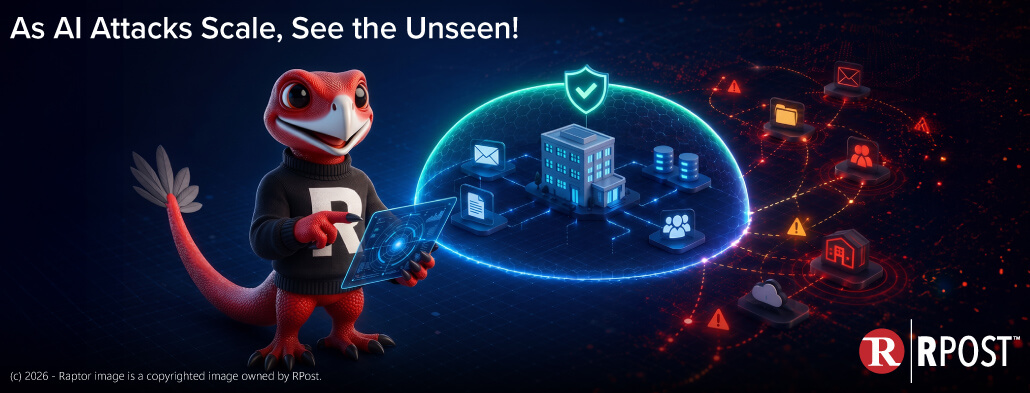
There’s a moment in every technology cycle when the conversation shifts from possibility to inevitability. In cybersecurity, that moment is happening now, and AI is driving it. And it’s no longer the era of more sophisticated hacking in the traditional sense; it’s something different - an environment where AI systems are operating against AI systems, often long before a human ever realizes an attack is underway.
Hey, Rocky the Raptor here, RPost’s cybersecurity product evangelist. Not long ago, cyberattacks required coordination, manual effort, and time. Even highly organized groups were constrained by human bandwidth. That constraint is disappearing.
Today, threat actors are deploying AI-driven agents that can move through digital environments with a level of persistence and scale that no human team could sustain. These agents are not simply scanning for open ports or outdated software. They are doing something far more strategic.
They are observing communication patterns, identifying high-value transactions, mapping relationships between parties, and learning how organizations behave under normal conditions. And they are doing it continuously.
These systems don’t sleep, don’t get tired, and don’t require direct oversight once deployed. They can monitor thousands of potential targets simultaneously, refining their understanding over time. In practical terms, this means that what used to be a targeted reconnaissance effort is now a distributed, automated process running in the background across entire industries.
Most businesses are not aware that this is happening. But in many cases, they are already being studied.
One of the more uncomfortable realities in cybersecurity is that attackers operate under a very different set of constraints than enterprises. Businesses must contend with regulatory compliance, data governance requirements, legacy infrastructure, internal approvals, and change management.
Attackers contend with none of that. They can adopt new tools instantly, experiment freely, fail, iterate, and redeploy without consequence. When AI capabilities become available, they are not evaluating risk frameworks or drafting policies; they are putting those capabilities to work.
This creates structural asymmetry. While enterprises are carefully integrating AI into workflows and decision-making, adversaries are using it to accelerate reconnaissance and refine attacks with a singular focus.
For decades, cybersecurity has been built around a reactive model - detect known threats, respond to anomalies, and contain damage. That model worked, or at least worked well enough, when attacks followed predictable patterns and unfolded over longer timeframes.
But that is no longer the case. When AI systems are conducting reconnaissance, the preparation phase of an attack becomes continuous rather than episodic, adaptive rather than static, and largely invisible to traditional tools. By the time a conventional security system detects something unusual, the attacker may already have mapped the organization’s workflows, identified key decision-makers, and gathered the context needed to execute a targeted fraud or breach.
In other words, the attack doesn’t begin when the malicious email is sent or the funds are redirected. It begins weeks or months earlier, during a phase that most security systems are not designed to observe, and it’s where the traditional model starts to break down.
What follows from this is a necessary shift in perspective. If attacks are being prepared well in advance, then detection must move upstream as well. This is the foundation of what is increasingly referred to as PRE-Crime™ cybersecurity - a model focused not on identifying attacks after they occur, but on detecting the signals that indicate an attack is in the prep phase.
Those signals are subtle, such as unusual access patterns to shared content, abnormal interaction with documents outside the organization, and early-stage reconnaissance behavior across third-party systems.
The objective is straightforward - identify risk while it is still in the planning stage, when intervention is possible, and impact can be avoided. So “defenders” must use AI to detect patterns, infer intent, and intervene before execution as traditional metrics, such as number of alerts, speed of response, or volume of blocked threats, begin to lose relevance.
What matters now is:
RPost’s RAPTOR™ AI is built around this idea. It looks beyond the traditional enterprise perimeter and analyzes interaction data generated after content leaves the organization. This is a different class of data than what most security systems rely on, and it provides visibility into activity that would otherwise go unnoticed.
There is a gap today between how risk is traditionally measured and how it actually manifests. For executives and boards, the implications are not purely technical, but financial and strategic. Cybersecurity is moving toward a preemptive, AI-driven model, not as an enhancement, but as a necessary layer.
Organizations will need visibility into how their information is being accessed beyond their own systems, early-warning indicators that something is amiss, and tools that can prevent loss, not just document it after the fact.
The next phase of enterprise security will be defined by the ability to see what is currently unseen. RAPTOR AI’s PRE-Crime capability sits right at this intersection - not as an incremental improvement, but as part of a broader shift in how organizations think about risk.

October 23, 2026

October 16, 2026

October 09, 2026

October 01, 2026

September 25, 2026





 Blog
Blog