


The FBI and Google have exposed a new generation of autonomous AI cyberattack agents capable of infiltrating organizations at machine speed. As these threats evolve, businesses face an unsettling question: What if the next cyberattack begins with intelligence gathering that their existing security defenses never detect?
Rocky the Raptor here, RPost's Cybersecurity AI Product Evangelist. I've been watching the headlines, and what a week this has been! Global business email disrupted, airlines grounded, banking transactions stalled, even the National Security Agency reported a temporary network degradation. A startling reminder of how dependent our world has become on interconnected technology systems.
Now, before anyone starts pointing talons (uh, fingers) at cybercriminals, these incidents have not been linked to cyberattacks.
But while the world was dealing with these disruptions, the FBI and Google were revealing something potentially more alarming - just how far autonomous AI-powered cybercrime has advanced, and what it could mean for businesses already struggling to keep pace.
On November 13, the FBI released a cybersecurity advisory detailing ARTEX, an autonomous penetration-testing framework weaponized by cybercriminals. Instead of relying on human hackers for every step, ARTEX (and other similar open source tools) uses specialized AI agents to conduct reconnaissance, discover vulnerabilities, exploit systems, escalate privileges, and steal sensitive information.
These capabilities can integrate with commercially available AI models, including Anthropic's Claude, OpenAI's GPT models, DeepSeek, GLM, and Kimi. While these are legitimate general-purpose technologies, cybercriminals can connect them to offensive tools to automate sophisticated attacks.
Three days later, Google Threat Intelligence Group and Mandiant reported that AI-driven cyberattacks had crossed a significant threshold. Researchers observed multi-agent frameworks coordinating offensive operations and automated systems analyzing newly patched software to identify exploitable vulnerabilities.
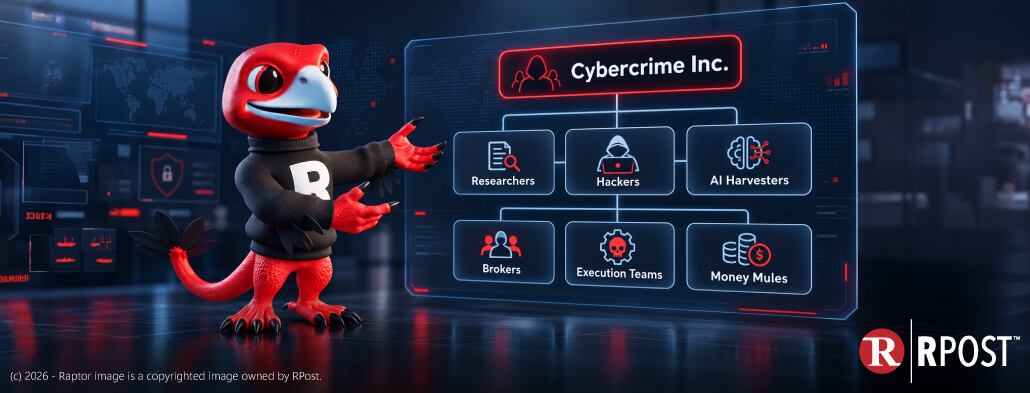
This is the rise of DarkAI: artificial intelligence weaponized for cybercrime, with autonomous agents working like a digital criminal syndicate that never sleeps, never tires, and adapts its tactics as it attacks.
For businesses, the next cyberattack may not begin inside their own networks. It could start with a compromised supplier, customer, adviser, or another trusted third party holding sensitive information.
Consider a confidential acquisition document emailed to an outside adviser. It passes the sender's security checks and reaches its intended recipient, perhaps even encrypted. But what if that adviser's account is compromised? An autonomous AI agent could examine correspondence, identify decision-makers, reconstruct transaction details, and determine exactly when to impersonate someone or redirect a multimillion-dollar payment.
The sending company's cybersecurity may have worked perfectly. The problem is that its sensitive information has moved beyond its security perimeter and into an environment it cannot control.
Yet even sophisticated AI agents can leave digital breadcrumbs. RPost AI Labs Threat Intelligence researchers have uncovered Soviet-aura fingerprints, among other types. Google's researchers observed that autonomous offensive frameworks can generate detectable network activity and forensic traces. For defenders, such signals offer opportunities to recognize suspicious activity before greater damage occurs.
This is where RPost's RAPTOR™ AI PRE-Crime™ Cyber Counterintelligence introduces a different approach to cybersecurity. Rather than focusing exclusively on malware, suspicious logins, and threats inside corporate networks, RAPTOR AI is designed to identify signs of hostile reconnaissance involving sensitive communications and protected content, including after delivery to third parties.
Imagine an attacker accessing a protected document through an anonymizing proxy or repeatedly retrieving sensitive information from an unusual application environment. Individually, these activities may be harmless. But when analyzed alongside available network intelligence, application fingerprints, timing, and behavioral patterns, they may indicate suspicious reconnaissance that conventional defenses could overlook.
While the attacker is gathering intelligence on the business, RAPTOR AI is gathering intelligence on the attacker. And RAPTOR AI's approach becomes especially powerful when combined with RPost's RDocs® rights-protected documents and AI Auto-Lock™.
RDocs helps organizations maintain visibility and control over protected documents even after distribution. When supported access controls and policies are in place, AI Auto-Lock can automatically restrict further viewing in response to suspicious activity, notify the document owner, and allow the owner to manage the restriction.
While information already copied cannot be recovered, further exposure can be limited. For CIOs and CISOs, that's the value of moving from reactive defense toward preemptive cyber counterintelligence.
As autonomous AI makes sophisticated cyberattacks faster and more accessible, organizations need to rethink what effective defense looks like. Detecting known threats is no longer enough. The emerging advantage is recognizing suspicious activity early enough to intervene.
And that's where I'll leave you this week. From my perch, DarkAI may be learning to hunt faster, but RAPTOR AI was built to spot the hunt before the strike.
November 20, 2026

November 13, 2026

November 06, 2026
October 30, 2026
October 23, 2026


 Blog
