




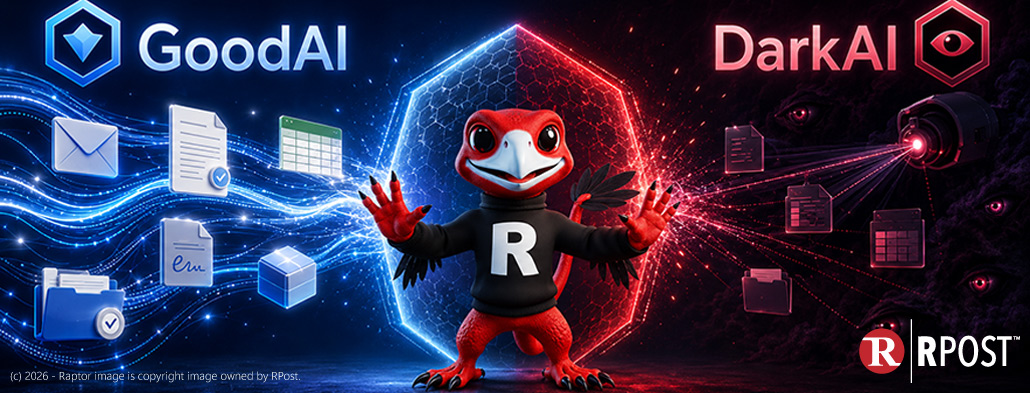
Rocky the Raptor here, RPost’s cybersecurity product evangelist, and I feel that the modern information worker has become the soft center of the digital economy.
I say this not because lawyers, insurance agents, accountants, consultants, bankers, brokers, advisors, and other professionals are careless. It’s quite the opposite; they are targeted because they sit where value, trust, timing, and confidential context intersect.
They know who is buying, selling, settling, suing, investing, acquiring, funding, disputing, insuring, advising, and signing. They see the documents before others do, understand the exceptions, know which wire instruction is urgent, which contract clause matters, which spreadsheet changes the negotiation, which claim is sensitive, which client is nervous, and which partner is likely to act fast.
That makes them essential to the business; it also makes them an axis of opportunity. Now add AI.
GoodAI is the approved, productivity-enhancing use of artificial intelligence to summarize, draft, compare, classify, prepare, route, and accelerate professional work. Management consultants use it to sharpen analysis, lawyers use it to review language and organize matter history, accountants use it to compare records and detect anomalies, insurance professionals use it to summarize claims, policies, and communications, and executives use it to move faster and look smarter while doing it.
This is not optional modernization. Clients expect speed, firms expect leverage, and younger professionals expect better tools. Senior partners and practice leaders want the gains without the operational risk. Everyone is being told to use AI to do more, faster, with fewer mistakes.
DarkAI is not one tool; it’s the attacker’s use of AI to make crime faster, cheaper, more convincing, and more scalable. It writes better phishing emails, studies stolen email threads, builds more plausible impersonations, helps criminals translate across languages, mimic tone, summarize stolen files, generate fake follow-ups, and understand the business context needed to strike.
The old phishing email was clumsy. The new one may read like it came from someone who sat in yesterday’s meeting.
That is the collision. Information workers are under pressure to use GoodAI to go faster, while criminals use DarkAI to exploit that same need for speed. The target is often the professional while the payoff is often the client.
Consider the lawyer handling a closing, the insurance broker managing a claim, the accountant moving tax records, or the consultant advising on a restructuring. The attacker may not care about embarrassing the professional; he/she just wants the wire, the settlement, the sensitive file, the client list, the private strategy, the contract package, the credentials, or the trusted reply path.
This is why cybercriminals increasingly focus on email account compromise, third-party compromise, and reconnaissance. They do not simply want to break into a system; they want to understand the story, know who trusts whom, which matter is live, which file is authoritative, which partner is copied, which vendor is new, which instruction is expected, and which deadline will force someone to act before they pause.
Once inside a mailbox, a document share, or a related third-party thread, the criminal may watch before acting. The attack becomes less about malware and more about context harvesting. Who sends payment instructions? Who approves? Who is traveling? Who is impatient? Who is deferential? Who will not want to slow the deal?
DarkAI can summarize stolen threads, profile relationships, draft the perfect pretext, and turn scattered context into a believable attack. It can help a criminal sound like a client, a partner, a vendor, a lawyer, or an internal executive. The attack does not need to be technically brilliant if it is socially and contextually precise.
That is why traditional defenses, while necessary, are no longer sufficient. Endpoint tools, email gateways, and identity controls matter. But information work happens in content - email, attachments, shared links, eSignatures, file transfers, forms, data rooms, PDFs, spreadsheets, drafts, approvals, and records of delivery. The attack surface is no longer just the device or inbox; it’s the business conversation itself.
RPostONE™ is built for the information worker under AI-era pressure. It is not a single-purpose tool bolted onto yesterday’s workflow. It brings together RMail email security, encryption, DLP, and compliance; Registered Email™ proof and Registered Encryption™ audit records; RSign eSignatures; RDocs document controls; secure file sharing; Double DLP; Zero-Day ICES inbox protection; and RAPTOR™ AI PRE-Crime cybersecurity.
That sounds like a lot because the problem is a lot! The difference is that RPostONE can be used as a complete platform or added modularly where the organization needs the layer.
A law firm may start with encrypted email, proof of delivery, eSignatures, and document controls. An insurance agency may focus on secure file sharing, payment fraud preemption, and mis-send protection. A consulting firm may need rights-controlled deliverables and safeguards against sensitive material being fed into uncontrolled AI tools, or a finance or accounting firm may prioritize audit records, client privacy, and preemptive detection of reconnaissance around high-value transactions.
The point is not to make professionals work harder at security, but to make secure work easier.
Inside familiar workflows such as Outlook, Microsoft Office, Exchange, email gateways, APIs, and MCP-connected AI environments, RPostONE helps information workers send, prove, eSign, encrypt, share, control, certify, and protect content without turning every task into a security project. It gives firms a way to use GoodAI while reducing the chance that sensitive content becomes training fuel, attack fuel, or ransom fuel.
RAPTOR AI adds the more forward-looking piece; it looks for signs that cybercriminals are studying content interactions before the strike. It is designed to help detect reconnaissance
suspicious access, impersonation preparation, stale shared content exposure, anomalous file access, and other patterns that may precede fraud or data loss.
That is PRE-Crime in practical terms - not science fiction or prediction, but earlier detection of the preparation phase.
For information workers, the future will not be slower. Clients will not ask for less speed, firms will not abandon AI, and criminals will not stop using DarkAI because defenders find it uncomfortable.
So, the question becomes simple - can professionals move faster without becoming easier to exploit? Rocky’s answer is yes; but only if security, proof, privacy, content control, and AI-era threat intelligence move into the workflow itself. Information workers are targeted because they hold the story. RPostONE helps make sure the story does not become the attacker’s playbook.
October 23, 2026
October 16, 2026
October 09, 2026
October 01, 2026
September 25, 2026





 Blog
Blog