




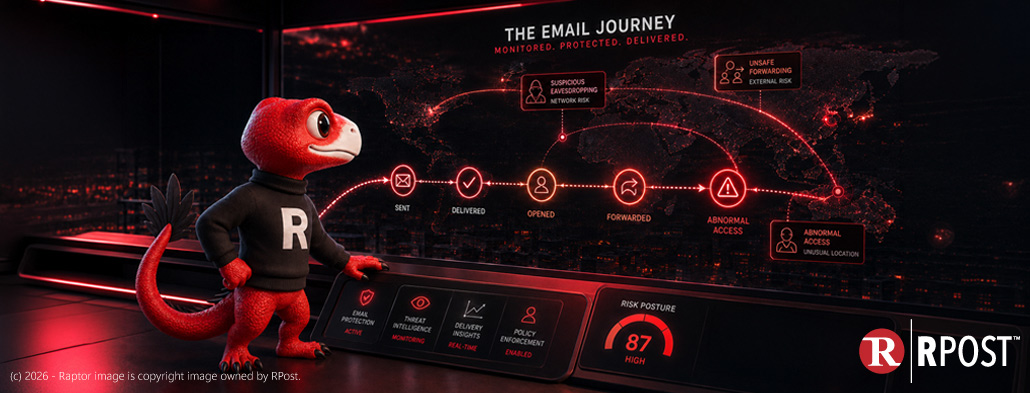
For most employees, email is still a blank box with a send button and an attachment icon. For security teams, it has become something very different - a delivery channel for attacks, a source of data leakage, an impersonation platform, and, increasingly, a reconnaissance tool for criminals and AI agents.
That is the problem with treating email security as a single product category. The risk does not begin and end at the gateway; it follows the message from arrival, through the inbox, out of the enterprise and into the hands and systems of customers, suppliers, advisers and AI tools.
Rocky the Raptor here, RPost’s cybersecurity product evangelist. Thinking about this topic, I couldn’t help myself from sharing why and how RPost has organized RMail Email Security with RAPTOR™ AI around that reality as eight complementary security layers.
(1) Inbound Gateway handles the familiar front door - reject, quarantine, or deliver. The business case is straightforward - keep spam, malware, and obvious threats from reaching employees.
(2) Integrated In-the-Inbox addresses attacks that survive the front door. A finance executive facing a convincing impersonation or reply-hijack attempt needs protection at the moment of decision, not merely another gateway log.
(3) Outbound Gateway DLP provides the classic stop-before-send control. If an employee is about to transmit regulated data or intellectual property where policy says it should not go, block it.
But humans make mistakes, and circumstances change, so...
(4) Double DLP™ extends protection into the cloud, helping pause risky delivery and act after send. Think of an employee attaching the wrong acquisition document or sending confidential material to the wrong counterparty. The important question then becomes whether the exposure can still be contained.
That leads to perhaps the biggest change in email security:
(5) PRE-Crime™ Cyber Counterintelligence treats legitimate outbound communications as a source of threat intelligence. A compromised supplier mailbox may silently watch conversations for weeks before criminals attempt payment diversion or impersonation. RAPTOR AI is designed to identify that reconnaissance, third-party risk, and related threat fingerprints earlier.
Then there is AI itself.
(6) AI-Era Threat & Observability addresses a new set of questions: Is sensitive content being sent to AI systems? Is an email carrying hidden prompt instructions to trick an AI agent that is organizing a user’s email into doing something nefarious? Is an AI-connected workflow being manipulated? Email is increasingly both an input to AI and an attack surface for it.
(7) Content Security protects what matters after the message leaves through encryption, compliance evidence, document rights, and persistent controls. For legal, healthcare, finance, or M&A teams, protecting the document may matter more than protecting the network it traversed.
Finally,
(8) Secure Workflows embed these controls into the way business actually gets done - secure file sharing, approvals, eSignatures, forms, and automated processes. Security that sits outside the workflow often gets bypassed; security built into it is far more likely to be used.
The commercial logic is equally important. Enterprises do not need another forced rip-and-replace project. RMail can sit alongside Microsoft and other existing gateways, with customers adding the layers that close their most urgent gaps.
Proofs of concept and proof-of-value deployments let them validate interoperability and security value before expanding. Email may look like one application. In reality, it is simultaneously a communications system, data-exfiltration path, identity surface, transaction network, and intelligence source for attackers.
Considering how business operates today and how attackers now exploit context, third parties, and AI, email security can no longer stop at the gateway. You really need RMail with RAPTOR AI protecting the full lifecycle.

October 09, 2026
October 01, 2026

September 25, 2026

September 18, 2026
September 16, 2026





 Blog
Blog