




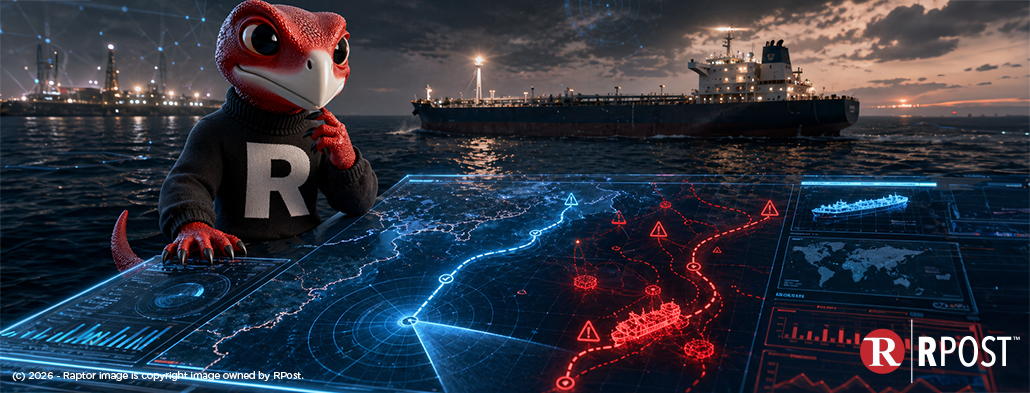
There’s a story unfolding far from corporate boardrooms, out in the open ocean across the Persian Gulf and beyond, that explains what’s happening in cybersecurity today. Way better than any technical whitepaper ever could! It involves oil tankers, but not ordinary ones - the kind that don’t want to be found.
Hey, Rocky the Raptor here, RPost’s cybersecurity product evangelist, and I have an interesting tidbit for you today. Fleets linked to Iran have perfected a kind of digital misdirection. On paper, or rather on screens, these ships appear to be somewhere else entirely. But in the oceans, a vessel physically moving through sanctioned waters suddenly shows up on tracking systems as sitting quietly near another country, or even inland in geographically impossible locations.
This isn’t science fiction. It’s called AIS spoofing - manipulating the Automatic Identification System signals that ships broadcast to report their position. Instead of transmitting real coordinates, the vessel sends fabricated location data, sometimes bouncing signals through virtual or misleading reference points to create a false trail.
To the untrained eye, or to systems relying on a single data source, the illusion holds. But not forever.
Here’s the thing about deception at scale: it’s never perfectly clean. Even the most sophisticated “ghost tankers” leave traces. Analysts have learned to look for subtle inconsistencies here, such as positions that don’t align with satellite imagery, physically impossible movement patterns, and identity signals that don’t match known vessel behavior.
When a ship claims to be in one place, but satellite data suggests otherwise, algorithms flag the anomaly almost immediately. And when you layer multiple data sources together - AIS signals, radar, imagery, behavioral patterns - the truth begins to emerge.
Not because the system was told where the ship is, but because it recognized what didn’t make sense. This is the key insight. Detection doesn’t come from trusting signals; it comes from interrogating them.
Let’s bring that lens into the digital world. Because what those tankers are doing at sea is almost exactly what modern cybercriminals are doing inside enterprise ecosystems. They:
To traditional security tools, the activity often looks legitimate, the logins appear valid, the device seems familiar, and the traffic pattern falls within expected thresholds. It’s the same illusion. A false signal, carefully constructed, designed to mislead systems that rely on surface-level validation.
What maritime analysts discovered, and what cybersecurity is now confronting, is that location and identity can no longer be taken at face value.
Just as a tanker can broadcast a false position, a cybercriminal can appear to be logging in from a trusted region, mimic a known user’s behavior, or operate through infrastructure that looks routine. The question is no longer: “Is this signal valid?” It’s “Does this behavior make sense when viewed in context?”
That shift - from validation to interpretation - is where artificial intelligence changes the game.
In the maritime world, AI models are now being used to cross-reference vast streams of data, tracking not just where ships say they are, but how they behave over time. That’s how analysts uncovered that a significant portion of Iran-linked tankers were using false flags and deceptive positioning to mask their operations.
The same principle applies in cybersecurity, and RPost’s RAPTOR™ AI operates on a similar premise: don’t trust the signal and analyze the behavior behind it.
Instead of focusing solely on login credentials or IP addresses, RAPTOR AI looks at interaction patterns with content:
It builds a behavioral model and then flags when reality diverges from that model.
Just like ghost tankers eventually reveal themselves through inconsistencies, cybercriminal operations do the same. They make mistakes, such as accessing data at the wrong time, interacting with content in unnatural sequences, or revealing patterns inconsistent with legitimate workflows.
Individually, these signals are subtle, but together, they form a fingerprint. And that fingerprint points back to the truth - not the location being claimed, but the location being inferred.
This is where cybersecurity is undergoing a fundamental shift. Traditional systems wait for malware execution, unauthorized access alerts, and data exfiltration events. But by the time those signals appear, the attacker has already succeeded in gathering context.
RAPTOR AI takes a different approach. It focuses on what happens before the attack:
This is what we refer to as PRE-Crime cybersecurity - identifying intent while it is still forming.
Much like maritime AI detecting a vessel whose path doesn’t make sense, RAPTOR AI identifies activity that doesn’t align with expected business behavior.
The scale is what changes everything. Just as maritime spoofing has grown into a global “shadow fleet” problem with layered deception, false identities, and coordinated tactics, cybercriminal operations have evolved into distributed, AI-assisted campaigns.
They don’t attack blindly anymore; rather, they study, map, and wait - across thousands of targets simultaneously. Without a way to see through the illusion, organizations are left relying on signals that were never designed to withstand this level of manipulation.
There’s a lesson in those ghost tankers: You can hide a signal, you can falsify a location, you can even construct an entirely believable narrative. But you can’t perfectly replicate reality at scale.
Somewhere, the pattern breaks. And the systems that matter most today are the ones capable of finding that break, not by trusting what they’re told, but by understanding what’s actually happening. That’s the difference between detection and insight, between reacting to an event and preventing it. And increasingly, it’s the difference between operating in the dark and seeing the threat before it ever surfaces.

October 09, 2026

October 01, 2026

September 25, 2026

September 18, 2026

September 16, 2026





 Blog
Blog