




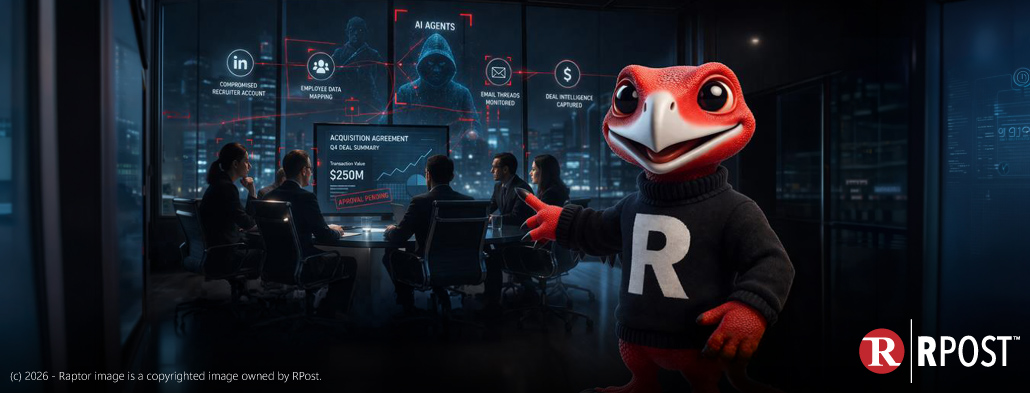
Rocky the Raptor here, RPost’s cybersecurity product evangelist. Today, I’m not just talking to the IT crowd, I’m talking to the boardroom. Because what I’m about to lay out isn’t theoretical or hype; it’s a live hunt already underway, and most businesses don’t even know they’re the prey.
For years, the sharpest IT and security teams have quietly observed something unsettling. Cybercriminals stopped “breaking in” the old-fashioned way; instead, they started studying you. Not casually or randomly, but systematically, patiently, and intelligently.
Here’s a step-by-step of what that looks like in the first phase:
They’re not hacking yet, but rather building a dossier. Then comes phase two.
Once targets are mapped, the attackers pivot. They head to dark web credential dumps and look for reused passwords and leaked credentials tied to employees, vendors, or partners. And here’s the key shift – they listen closely.
They don’t brute force logins anymore. Instead, they use valid stolen credentials, relay access through compromised consumer devices (think: a hacked home laptop near your office), and mimic human behavior patterns -- logging in at realistic times, pausing, navigating slowly.
This is long-game infiltration, and this is where the concept of Man-in-the-Middle (MITM) quietly evolved. The “middle” is no longer the network; it’s now the trusted digital identity -- your employee, your vendor, or your partner.
Now enter Anthropic’s Mythos. When Mythos was announced, it didn’t introduce something entirely new; it did something far more dangerous. It validated and accelerated what cybercriminals were already doing.
As our CEO says, “AI agents can now operate at a speed no human team could match, at scale across thousands of targets, and with creativity to find new paths into your business.”
Let me translate that into plain business risk. This is no longer a cybersecurity issue; it’s a financial risk, a reputational risk, and a fiduciary liability. It is now a board-level concern.
Now, let’s talk facts, not fear. In just the last quarter, RPost’s RAPTOR™ AI uncovered:
Let that sink in. These aren’t hypothetical attacks, but live, in-progress cyber hunts happening before the fraud, before the breach, before the headlines.
You’ve heard of MITM before. But you were thinking of wi-fi sniffing, email interception, and network-level attacks. That’s old thinking. Today’s MITM looks like this:
This is pre-crime MITM, where the attacker is already in position before the transaction happens. They’re not intercepting blindly, but waiting with precision.
Here’s the uncomfortable truth - your company might be secure, your employees might be trained, but your third parties (law firm, escrow provider, supplier, investor, etc.) AREN’T. And that’s where attackers live. If any one of them is compromised, the attacker gains a front-row seat to your business operations. And from there, it’s just a matter of timing.
Are you still wondering why traditional security can’t see this? Your firewalls, email filters, endpoint protection – everything is completely blind. Because the attacker is using real credentials, operating from trusted environments, and behaving like a legitimate user.
There’s no “malware signature” or obvious red flag; just a predator moving quietly through your ecosystem.
This is where RPost’s RAPTOR AI changes the game. While others defend the perimeter, RAPTOR AI sees beyond your endpoints, detects active reconnaissance behavior, identifies third-party compromise signals, and flags threats before money moves.
It doesn’t wait for the breach; rather, it identifies the setup. And in today’s world, that’s everything, as once the wire is sent and the fraud is executed, it’s already too late.
Let me leave you with this:
If your organization cannot see active cybercriminal reconnaissance, you are already at a disadvantage. RAPTOR AI is the difference between being watched and knowing you’re being watched. And that difference is everything.
October 09, 2026
October 01, 2026

September 25, 2026
September 18, 2026
September 16, 2026





 Blog
Blog